
Blog
How Mileage, Upgrades, and Aftermarket Equipment Change Your RV's Appraised Value
How does mileage affect RV value? It's one input in a layered adjustment process, not a fixed per-mile deduction. This guide walks through how appraisers move from a base guide value to a defensible final number using mileage, condition, upgrades, and market evidence.
Owners searching for a single answer to "how does mileage affect RV value" are usually disappointed. There isn't a universal dollar-per-mile rule that a bank, insurer, or court will accept. What actually happens in a professional appraisal is a layered process: start from a base guide value, then adjust it step by step for mileage, condition, upgrades, and options, with every adjustment tied to real market evidence.
That distinction matters more than it sounds. Whether you're preparing for an RV appraisal for insurance claim purposes, refinancing, or settling an estate, the number that survives scrutiny is the one built on comparable sales, not a guess pulled from a mileage chart.
How Does Mileage Affect RV Value?
Mileage lowers or raises a motorhome's value as a comparable-sales adjustment, and the size of that adjustment depends on the unit's age, drivetrain, and documented maintenance, not a fixed formula. Lower mileage relative to similar units for that model year generally supports a higher value, while unusually high mileage typically pulls value down because it signals more wear on the drivetrain and chassis.
Mileage is mainly relevant to motorized RVs (Class A, B, and C motorhomes). For towable units like travel trailers and fifth wheels, mileage matters only to the extent it reflects usage and wear, since there's no engine or transmission to depreciate. Some published calculators offer a flat rule of thumb, such as a set amount per mile, but no authoritative industry standard treats that as an official adjustment. It's a starting estimate at best, and an appraiser who relies on it without comparable data is skipping the actual analysis, as RVshare's overview of RV valuation makes clear.
High mileage with meticulous maintenance records can outperform low mileage with signs of neglect. Unusually low mileage on an older unit can also raise flags: long storage periods often mean deferred maintenance, dry-rotted seals, or fuel system issues that a buyer (or an appraiser) needs to account for.
Starting Point: The Base Guide Value
An appraisal doesn't start from scratch. It starts from a published base guide value (the kind of figure you'd find in a J.D. Power or NADA-style guide) for the RV's year, make, model, and floor plan. That number reflects average condition and average mileage for the model year, drawn from national sales data.
The guide value is a reference point, not the answer. Our guide comparing appraised values to NADA-style guide numbers covers why the published figure and a defensible appraised value routinely diverge once real market conditions and unit-specific factors are applied.
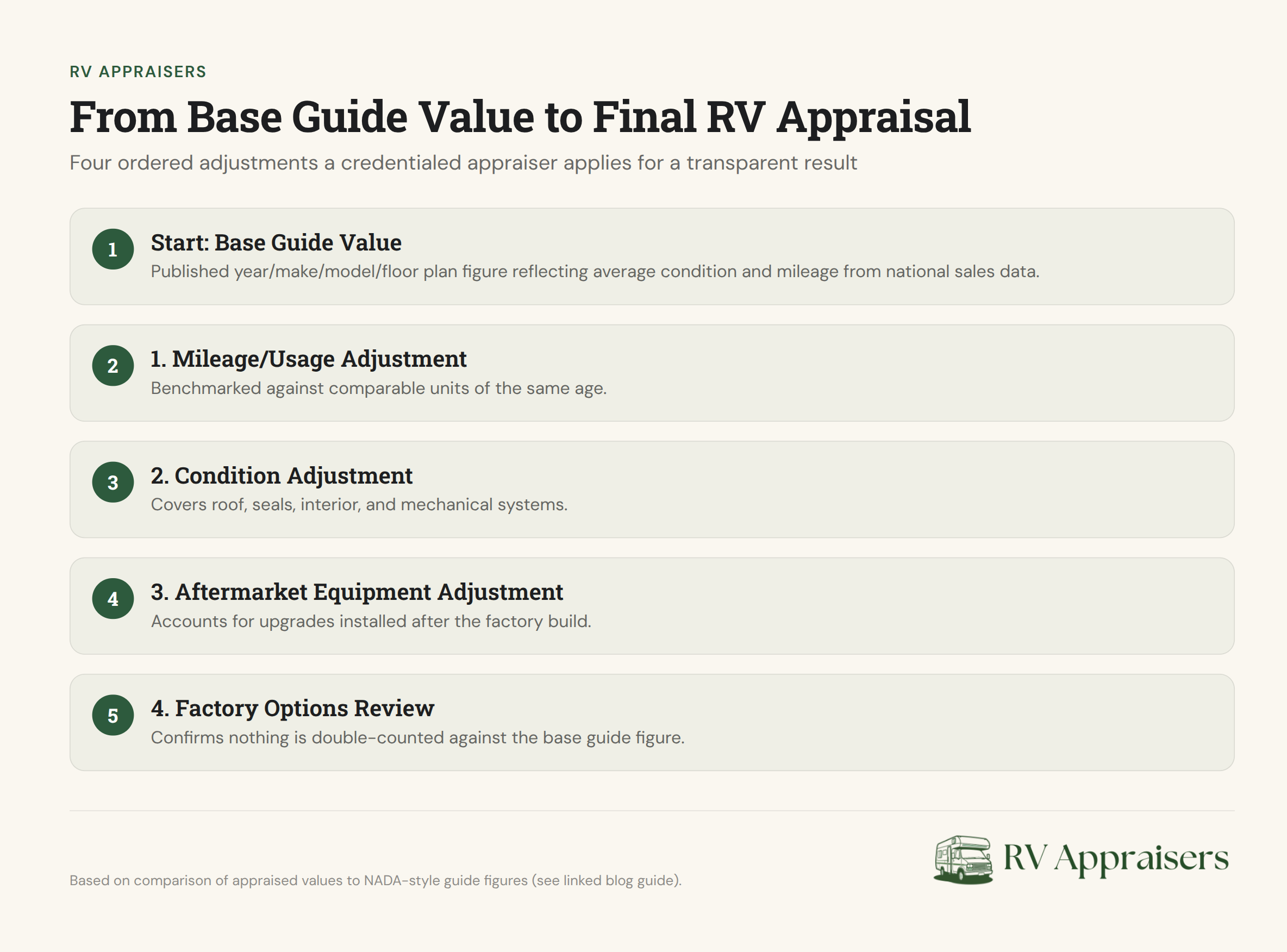
From that starting number, a credentialed appraiser applies adjustments in a consistent order so the math stays transparent:
- Mileage or usage adjustment, benchmarked against comparable units of the same age.
- Condition adjustment, covering the roof, seals, interior, and mechanical systems.
- Aftermarket equipment adjustment, for upgrades installed after the factory build.
- Factory options review, to confirm nothing is being double-counted against the base guide figure.
Layering in Condition Adjustments
Condition is often the single largest swing factor in an RV appraisal, and it covers more ground than most owners expect. A comparable-sales adjustment for condition typically weighs the roof membrane and seals, water intrusion history, interior wear (flooring, upholstery, cabinetry), slide-out mechanisms, and the mechanical and chassis systems for a motorized unit.
An RV with a recently resealed roof, documented generator service, and no history of water damage will command a real premium over an outwardly similar unit with soft spots in the subfloor or a neglected awning. Buyers pay for confidence that they aren't inheriting a deferred-maintenance problem, and comparable sales data reflects that willingness to pay. General guidance on how appraisers separate condition, age, and mileage when developing a valuation for insurance or total-loss purposes reinforces the same point: these factors move together, and treating them as independent line items produces a distorted number, as industry commentary on reading comparables behind a total-loss valuation describes.
Watch out: A cosmetically clean RV with an undocumented mechanical history isn't automatically a strong comparable. An appraiser needs maintenance records, not just photos, to support a condition-based upward adjustment.
Aftermarket Upgrades: Contributory Value, Not Retail Cost
Aftermarket additions such as solar arrays, lithium battery banks, upgraded suspension, larger generators, or custom awnings can increase an RV's appraised value, but not by what the owner paid to install them. Appraisers assign what's called contributory value: the amount the upgrade actually adds in the current resale market, supported by comparable listings or paired-sale evidence.
A 400-watt solar system with a lithium battery bank that cost $6,000 installed might only add $2,000 to $2,500 to the appraised value, because that's what the market evidence supports buyers are actually willing to pay extra for that feature on a comparable unit. To count toward value, an aftermarket addition generally needs to be:
- Permanently installed and compatible with the RV's existing systems.
- Safe, legal, and fully operational, not partially wired or in progress.
- Documented with invoices, specifications, or warranty paperwork.
- Reflected in how comparable units with the same feature have actually sold.
A well-integrated electrical or solar upgrade tends to hold more of its value than a highly personalized interior build-out, because the electrical upgrade broadens the RV's appeal (off-grid capability sells) while heavy customization can actually narrow the buyer pool.
Factory Options Already Baked Into Guide Data
It's worth separating factory-installed options from aftermarket additions, because they're treated differently. Base guide values already reflect a range of factory equipment. Air conditioning, appliance packages, awnings, entertainment systems, and slide-out configurations that were optional for that specific model and year get evaluated against what the guide already assumes as standard equipment.
The practical rule: an option that exceeded the model's standard configuration when new can support an upward adjustment if it's present and functional, but equipment already built into the standard configuration doesn't get counted twice. An appraiser who adds value for a factory feature that the guide already assumes as baseline is inflating the number, and that kind of error is exactly what shows up under scrutiny in a financing or insurance dispute.
Why Adjustments Need Market Evidence, Not Fixed Percentages
Every adjustment described above (mileage, condition, upgrades, options) has to be supported by something concrete: a paired sale, a set of comparable listings, dealer data, or auction results showing what the market actually paid for that difference. The Uniform Standards of Professional Appraisal Practice, published by The Appraisal Foundation, require an appraiser to explain and support each adjustment rather than apply a fixed, unexplained schedule. There's no USPAP-sanctioned table that says mileage costs exactly so many cents per mile or that solar panels add a flat percentage.
That's a feature, not a gap. RV markets vary regionally and shift by season, and a fixed percentage schedule would produce a wrong number in half the cases. Building a defensible comparable set is its own skill; our guide on finding comparable RV sales when guide book numbers fall short walks through how to source and adjust real transaction data rather than lean on a single guide figure.
Worked Example: From Base Value to Indicated Value
Here's how the layering actually plays out on a real unit. Consider a 2019 Class C motorhome with a published base guide value of $72,000 for average mileage and average condition at that model year.
| Adjustment Step | Basis | Amount | Running Value |
|---|---|---|---|
| Base guide value | Average mileage, average condition for model year | Starting point | $72,000 |
| Mileage adjustment | 38,000 miles vs. 55,000-mile comparable average; low-mileage comps traded $2,500-$3,000 higher | +$2,800 | $74,800 |
| Condition adjustment | Roof reseal overdue, interior wear beyond typical for age | -$3,500 | $71,300 |
| Aftermarket upgrade | 400W solar + lithium battery bank, contributory value from comparable listings (not $6,000 install cost) | +$2,200 | $73,500 |
| Factory options | Already reflected in base guide figure; no adjustment | $0 | $73,500 |
| Indicated value | $73,500 |
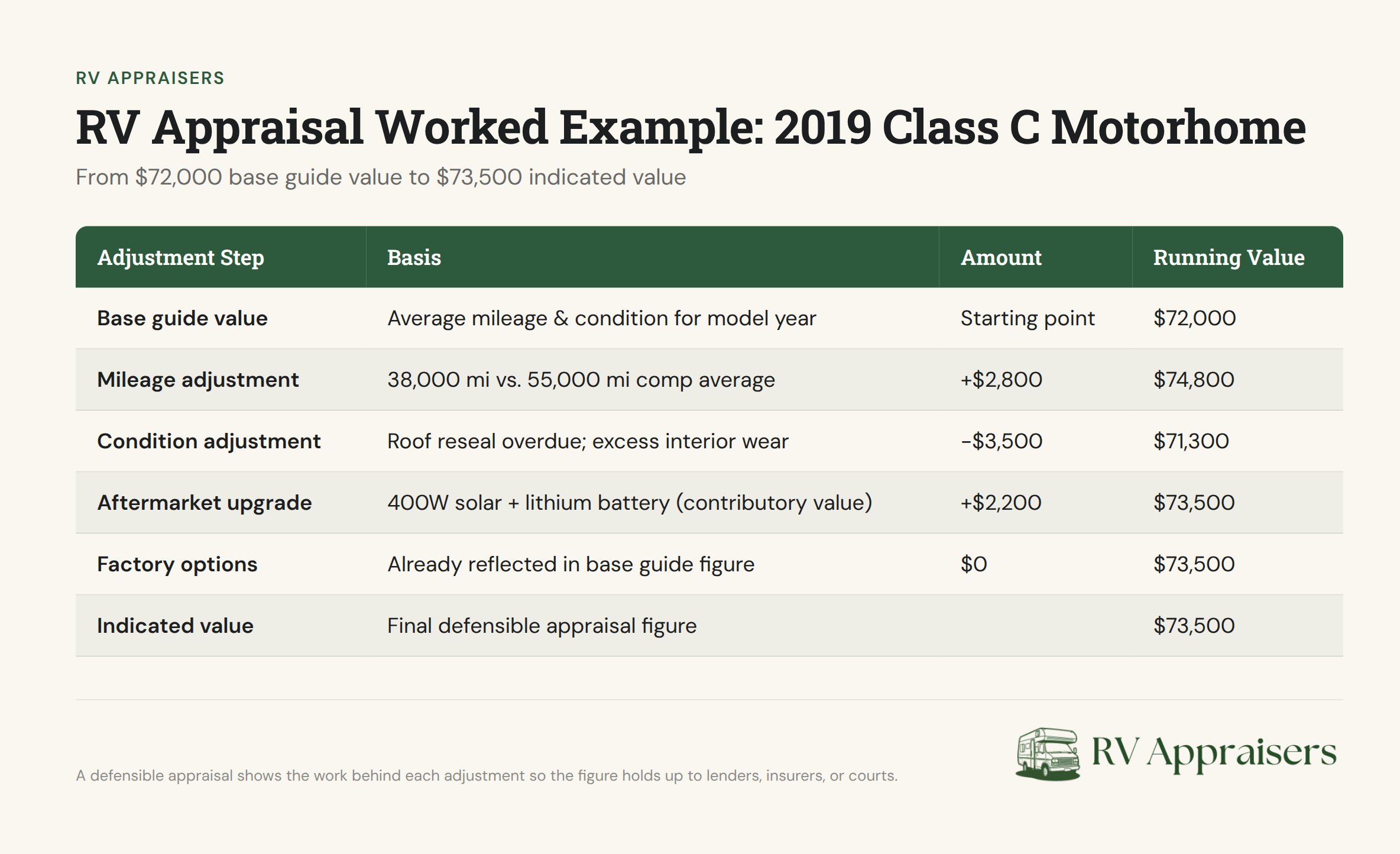
Notice that the final number ($73,500) sits close to the starting guide figure ($72,000) even though two sizable adjustments were made in opposite directions. That's typical. A defensible appraisal isn't about finding a dramatically different number from the guide; it's about showing your work so the figure holds up when a lender, insurer, or court asks how you got there.
When Personalization Hurts Marketability
Not every dollar spent on an RV comes back at resale, and heavy personalization can actually work against value even when the owner loved the result. A fully custom interior, a non-standard paint wrap, or a removed dinette in favor of a workshop layout narrows the pool of buyers who want exactly that configuration. Comparable evidence for a heavily customized unit is also harder to find, since there are fewer directly similar sales to draw from.
That doesn't mean customization always hurts. Upgrades that improve utility broadly (solar, lithium, tow packages, suspension) tend to widen appeal. Upgrades that reflect one owner's specific taste (a themed interior, a non-standard floor plan) tend to narrow it. An appraiser weighing both has to ask whether the next likely buyer for that RV type would pay for the change or would need to reverse it.
Getting a Defensible Number for Your RV
A guide book value is a reasonable starting point for a casual sale, but it isn't an appraisal. When the RV's value needs to hold up for insurance, financing, an estate, a divorce settlement, or an IRS filing, the mileage, condition, upgrades, and options all need individual, evidence-backed adjustments rather than a single lookup number.
Our appraisers scope every engagement before quoting a fixed fee, based on the RV's complexity, the intended use of the report, and the depth of comparable research required. There's no hourly billing and no surprise invoice; you know the cost before we start. If you're ready to get a documented, defensible value for your motorhome, travel trailer, or fifth wheel, you can request an RV appraisal and our team will scope the assignment from there.
This article is provided for general informational purposes only and does not constitute legal, tax, or financial advice. Readers should consult a qualified attorney or CPA regarding their specific circumstances.