
Blog
How to Find Comparable RV Sales When Guide Book Numbers Fall Short
NADA and J.D. Power values average across too many regions and configurations to price your specific rig. This guide walks through building a real comp set from active listings, sold prices, and owner forums so you know what your RV is actually worth.
Type a 2018 half-ton travel trailer or a 2015 diesel pusher into the NADA or J.D. Power RV guide and you get one tidy number. Pull up ten similar units for sale in your region and half of them sit thousands above that figure while half sit thousands below it. The guide isn't broken. It's simply averaging across a national market that has little to do with your specific floorplan, your region, or this month's local demand. Our appraisers build RV appraisal reports around real comparable sales for exactly this reason, and the same workflow works whether you're selling privately, buying used, or just trying to sanity-check a number before you sign anything.
Why the Guide Book Number and Your Local Listings Disagree
Guide values are built from broad national averages and manufacturer suggested pricing, not from the actual sale price of the unit sitting in your driveway. There isn't even a single "Kelley Blue Book for RVs" the way there is for cars: J.D. Power and NADA-style guides serve as the main national reference, but published industry guidance is explicit that buyers and sellers still need to check live market listings for similar RVs rather than relying on the guide alone.
State valuation manuals confirm the guide is only a starting point. Kansas's own personal property valuation guidance instructs assessors to value newer campers and travel trailers at a percentage of suggested list price, older models at average retail, and to fall back on an alternate blue book entirely when the primary guide doesn't fit, a workflow laid out in the Kansas Personal Property Valuation Guide. If the people who write valuation rules for a living treat the guide as one input among several, a private seller or buyer should too, especially for niche floorplans, older units, or regions with unusual seasonal demand like snowbird destinations or lake towns. We covered how far guide values and real appraised values can diverge in our deeper look at NADA guide accuracy if you want the full picture before you start building a comp set.
Key takeaway: treat the guide number as a reference range, not a final answer. The real work is building a comp set from what's actually selling near you, right now.
The Five-Step Workflow for Building a Real Comp Set
Professional appraisers rely on a sales comparison approach: gather sales of similar property, then adjust for the differences between those comparables and the subject. You can run a simplified version of the same process yourself.
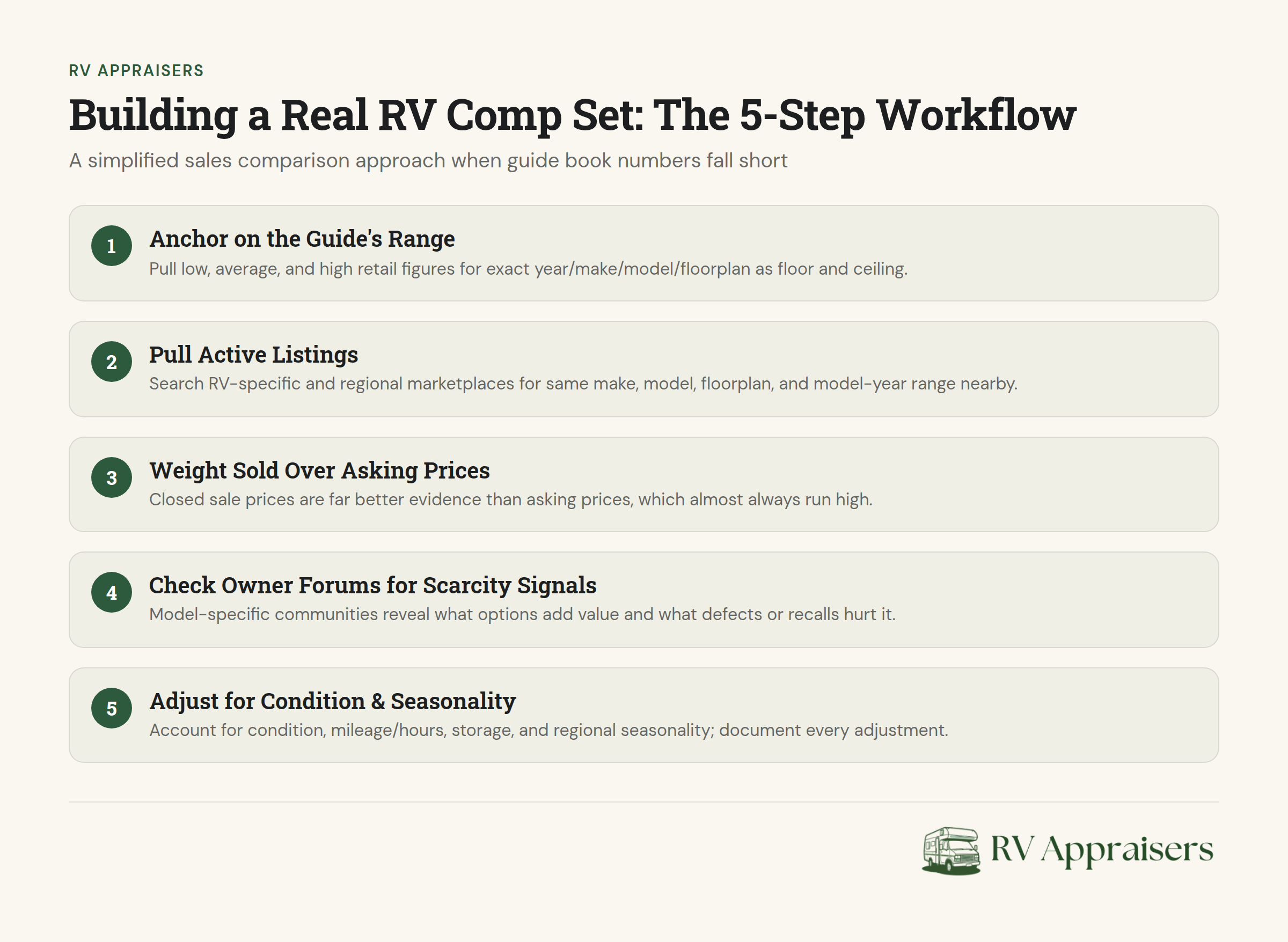
- Anchor on the Guide's Range, Not a Single Number
- Pull the low, average, and high retail figures for the exact year, make, model, and floorplan, and treat that spread as your floor and ceiling.
- Pull Active Listings from RV-Specific Marketplaces
- Search RV-specific listing sites and regional marketplaces for the same make, model, floorplan, and model-year range within a reasonable radius of your market.
- Weight Sold or Closed Prices Over Asking Prices
- When you can find them, closed sale prices are far better evidence than asking prices, which almost always run high.
- Check Owner Forums and Community Groups for Scarcity Signals
- Model-specific communities will tell you what options actually move price and what defects or recalls quietly drag it down.
- Adjust for Condition, Mileage or Hours, Storage, and Regional Seasonality
- Document every adjustment you make so the final number holds up if a buyer, insurer, or lender questions it.
Why Sold Prices Beat Asking Prices Every Time
An asking price is a seller's opening position, not proof of what a buyer actually paid. Valuation standards define comparable evidence as data drawn from actual transactions, and industry standards for comparable evidence emphasize that the most reliable market data comes from completed sales rather than offers or listings alone. The same logic applies directly to RVs.
Example: A 2019 Class C with a rear-bath floorplan might carry an asking price of $68,900 on three different listing sites. If two comparable units actually sold at $61,500 and $63,000 after 45 and 60 days on the market, those two sold prices are the stronger evidence of what your unit is worth today, not the $68,900 asking figure everyone is anchored to.
Pro tip: Days-on-market matters almost as much as the price itself. A unit that sold quickly at a given number tells you more about true market value than one that sat for four months before finally selling below asking.
What Forums and Owner Groups Reveal That No Guide Can
Model-specific owner forums and social media groups surface information that never makes it into a pricing guide: known manufacturing defects, slide-out or leveling system issues tied to a specific production run, and which factory options (solar packages, disc brakes, upgraded suspension, four-season insulation) actually command a premium on that particular model.
They also reveal scarcity. A discontinued floorplan, a short production run, or a color combination that buyers specifically hunt for can move a comp set by real money.
Watch out: A rare floorplan or a well-documented defect can swing value 10% to 15% in either direction, and no national guide tracks either one at the model-specific level. If your forum research turns up either signal, weight your comps accordingly rather than trusting the guide's flat number.
Adjusting for Condition, Mileage, Storage, and Season
Once you've assembled real comps, the remaining work is adjustment. Mileage or engine hours, whether the unit was stored under cover or left exposed, daily use versus occasional weekend use, and regional seasonality (snowbird markets often pay a premium heading into fall, mountain and lake markets often pay more in spring) all move the number up or down from your comp set's midpoint.
Professional appraisal practice also bounds how far back a comparable sale can reach before it stops being useful evidence. In a related field, Fannie Mae's appraisal reporting requirements call for a 12-month comparable sales history on standard appraisal forms, a useful reminder that markets shift and a sale from two years ago is weaker evidence than one from last month. For RVs, tighten that window further where you can. A comp from 18 months ago in a market that's since cooled or heated up will mislead you more than it helps.
Live market data, not just guides, should also inform your search radius. Owner communities and marketplace research consistently point sellers back toward checking actual current listings for comparable units rather than stopping at a single reference number.
When the Comp Set Gets Too Thin for a DIY Approach
Sometimes there simply aren't enough comparable sales to build a defensible number on your own: a custom or limited-production coach, a disputed total-loss or diminished-value insurance claim, an estate or divorce proceeding, or a loan application where the lender needs a documented, third-party figure. That's when a professional appraisal earns its cost.
Our appraisers use the same sales comparison approach described above, just with broader access to closed-sale data most consumers can't see, and every adjustment is documented so the concluded value holds up under scrutiny from an insurer, a court, or a lender. Our appraisers hold credentials with organizations such as the ASA, ISA, and CAGA, and every report is prepared in accordance with USPAP. A standard recreational vehicle appraisal is quoted as a fixed fee starting at $195, with IRS-qualified reports starting at $295, priced after we scope the specific assignment rather than billed by the hour.
If your comp set is thin, your rig is unusual, or the number just needs to hold up to someone else's scrutiny, request an RV appraisal and let a credentialed appraiser build the comp set for you.