
Blog
Are RV Appraisals Accurate? Why NADA Guide Values Often Tell a Different Story
RV appraisals and NADA/J.D. Power guide values disagree because they answer different questions. This guide explains when a guide number is enough and when you need a certified, assignment-specific RV appraisal instead.
If you've ever pulled a NADA or J.D. Power value for your motorhome, then paid an appraiser to look at the same rig, and gotten two different numbers, you're not imagining things. It happens constantly, and it isn't a sign that either figure is wrong. It's a sign that the two tools are built to do different jobs.
This matters more than it sounds like it should. A guide value is fine for a quick gut check before a trade-in conversation. It is usually not fine when an insurer, lender, the IRS, a court, or an estate needs a defensible, dated opinion of what your specific RV is worth. Getting that distinction backward is how owners end up underinsured after a loss or with a donation deduction the IRS won't honor.
What Is a NADA RV Value Guide, Really?
The NADA RV Value Guide, now published under the J.D. Power brand, is an aggregated market-reference tool. It reports averaged pricing by make, model, model year, and trim, built from broad transaction data across the country, not from an inspection of your particular unit.
That structure is exactly why owners get surprised. Guide publishers themselves caution that their numbers are estimates, not guarantees of what a specific vehicle will sell for, a point confirmed in industry coverage of how these guides are compiled and disclaimed MSN's review of NADA and J.D. Power used-vehicle values. The guide is doing statistical averaging across thousands of similar units. Your RV is one specific unit with its own mileage, upgrades, and history.
Pro tip: Treat a guide number as a starting range, not a final answer, especially before you list a rig for sale or walk into a dealership trade-in appointment.
What Is a Certified RV Appraisal?
A certified RV appraisal is an assignment-specific opinion of value. It is prepared in accordance with USPAP (Uniform Standards of Professional Appraisal Practice), built from verified comparable sales, a hands-on or documented condition inspection, and a defined effective date that ties the value to a specific moment in time.
Owners typically order one for a defined purpose, not general curiosity:
- Proving replacement cost or actual cash value after a covered loss, which is the basis for an RV appraisal for an insurance claim.
- Establishing a defensible date-of-death value when an RV is part of a decedent's estate, which is the purpose behind an RV appraisal for estate tax.
- Substantiating fair market value on a coach donated to a qualified charity, which is where an RV appraisal for an IRS charitable donation comes in.
Each of those situations puts a third party in the room, an insurer, the IRS, a court, or an estate's beneficiaries, and that third party needs more than an averaged guide figure. They need an opinion someone stands behind, with documentation to support it.
Why the Numbers Often Disagree
Guide values and appraisals disagree because they start from different inputs and answer different questions. A handful of structural gaps explain almost all of the difference:
- Condition is generalized in the guide, individualized in the appraisal. NADA and J.D. Power values use broad condition brackets (excellent, good, fair), so two RVs with the same guide entry can have real-world values that are far apart once an appraiser actually inspects them as RV owners and industry writers have discussed at length.
- Options and modifications get lost in the average. Full-body paint, solar packages, upgraded suspension, custom interiors, and diesel-versus-gas drivetrains all move real market value, but a standardized guide entry can't capture unit-specific equipment the way an inspection can.
- Rare and collectible units break the averaging model. A vintage Airstream, a Prevost conversion, or a low-production custom coach doesn't have enough comparable transaction volume for a guide to average meaningfully. These are exactly the cases where guide numbers and real sale prices diverge the most, similar to how limited-production boats or fine art resist simple pricing formulas.
- Regional demand isn't uniform. A guide reports a national or regional-band estimate; actual local supply and buyer demand can push real prices well above or below that estimate, a gap dealers and appraisers see routinely when comparing book numbers to actual wholesale transactions per industry commentary on guide values versus real sale data.
- Guides update periodically, not in real time. Market shifts, changing dealer inventory, and seasonal demand swings can leave a published guide number stale by the time you're using it, something owners researching current financing options run into often when comparing lender-quoted values to guide figures.
Watch out: None of this means the guide is "wrong." It means the guide was never built to answer the question a specific insurer, lender, or court is actually asking.
Guide Value vs. Certified Appraisal: Side by Side
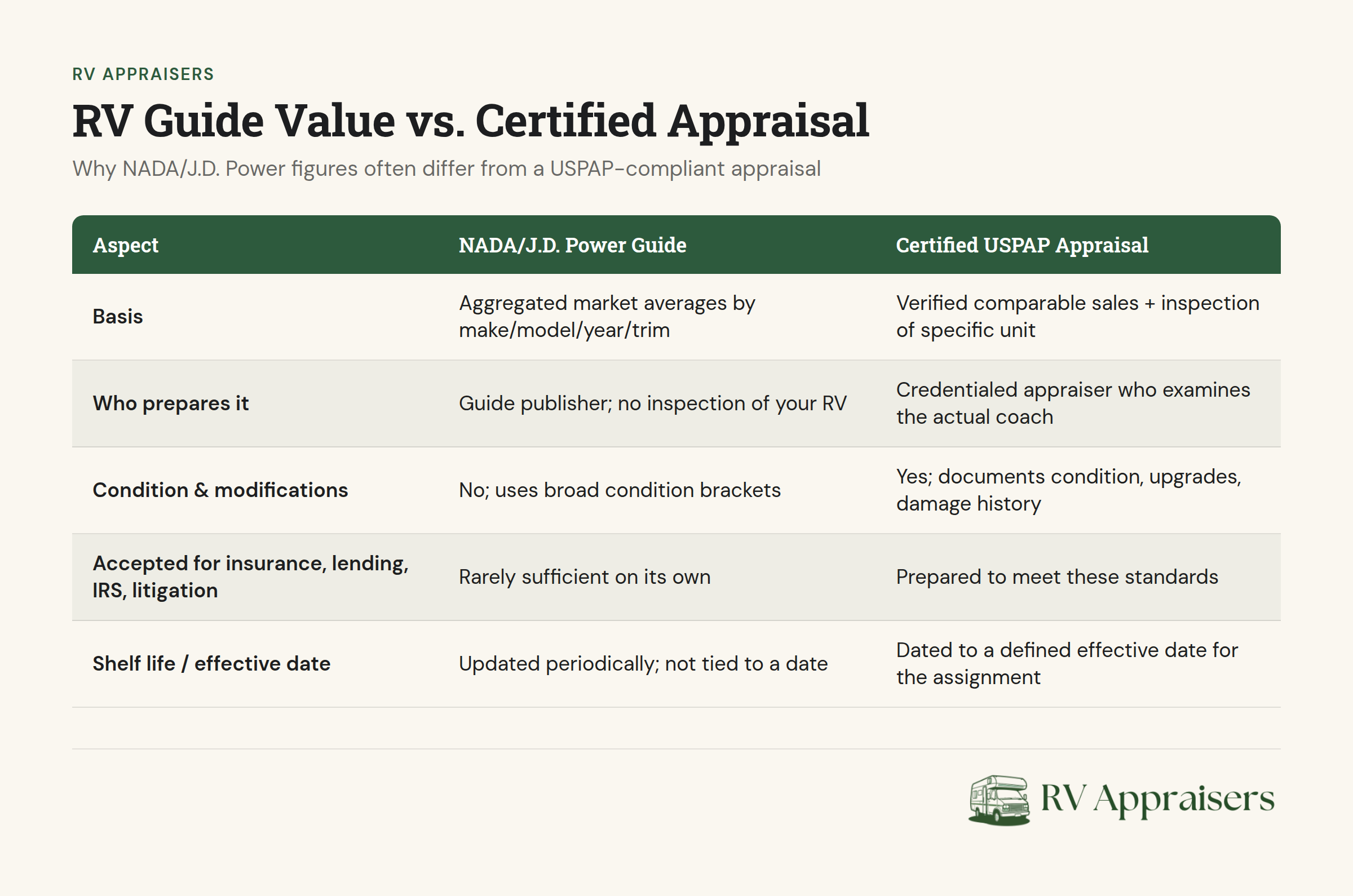
The cleanest way to see the difference is to line the two tools up against the questions that actually matter to a third party.
| Aspect | NADA/J.D. Power RV Value Guide | Certified USPAP-Compliant Appraisal |
|---|---|---|
| Basis | Aggregated market averages by make, model, year, trim | Verified comparable sales plus inspection of the specific unit |
| Who prepares it | Published guide company; no inspection of your RV | A credentialed appraiser who examines the actual coach |
| Accounts for condition and modifications | No; uses broad condition brackets | Yes; documents actual condition, upgrades, and damage history |
| Accepted for insurance, lending, IRS, estate, litigation | Rarely sufficient on its own | Prepared to meet these standards |
| Shelf life / effective date | Updated periodically; not tied to a specific date | Dated to a defined effective date for the assignment |
When a Guide Value Is Good Enough
A guide number earns its keep in low-stakes, routine situations. If you're getting a rough sense of trade-in leverage before you walk into a dealership, or sanity-checking a private-party asking price on a standard-production travel trailer in average condition, the guide is a reasonable starting point. It's fast, free or low-cost, and close enough for a negotiation opener.
Where it falls short is anything involving unique condition, modifications, a diesel pusher versus a gas chassis, full-body paint, a rare manufacturer, or any history of damage or major repair. Those variables simply aren't in the guide's averaged data set.
When You Need a Certified Appraisal Instead
Anytime a third party has to accept your number, reach for the certified report instead of the guide printout. That includes insurance claims after a fire, collision, or weather event; financing and refinancing where a lender needs collateral verification; IRS charitable donation deductions; estate and probate settlements; and divorce or other litigation where a court needs a defensible figure.
The IRS makes this distinction explicit for donated property. General IRS guidance on non-cash charitable contributions notes that commercial pricing guides are useful for context but are not considered an official appraisal of a specific donated item, and a taxpayer claiming a deduction above the applicable threshold needs a qualified appraisal, not a guide printout see IRS.gov for current requirements on substantiating non-cash donations. The same logic extends naturally to insurers, lenders, and courts: they all want an opinion tied to your specific RV, on a specific date, from someone who actually looked at it.
Key takeaway: A guide value tells you what similar RVs have averaged. A certified appraisal tells a third party what your RV, in its actual condition, on a specific date, is defensibly worth.
Getting a Number You Can Actually Use
RV owners searching "are RV appraisals accurate" are usually trying to reconcile a number that doesn't match what they expected. The honest answer is that a certified appraisal and a NADA RV value guide are measuring different things by design. The guide is a market-wide average; the appraisal is a documented, defensible opinion built around your specific unit, its condition, and the purpose you need the number for.
If you're facing an insurance claim, a loan application, an estate settlement, a donation, or a dispute, a guide printout won't carry the weight a certified appraisal will. Our team prepares USPAP-compliant RV appraisals built around verified comparables and a real condition assessment, quoted as a fixed fee once we understand the scope of the assignment.
This article is provided for general informational purposes only and does not constitute legal, tax, or financial advice. Readers should consult a qualified attorney or CPA regarding their specific circumstances.