
Blog
Which RV Holds Its Value Best: Motorhomes vs Travel Trailers vs Fifth Wheels
Motorhomes, travel trailers, and fifth wheels depreciate on different curves, and knowing which one holds its value best can save or cost you thousands at resale. This guide breaks down first-year drops, 5-year retention, and the real drivers of RV resale value by class.
Buying an RV is rarely just about the sticker price. Whether you plan to trade it in for a newer model, sell it privately in five years, or use it as loan collateral down the road, resale value belongs in the purchase decision from day one. This guide compares depreciation curves across the three major RV classes, motorized (Class A, B, and C), travel trailers, and fifth wheels, so you can weigh long-term value retention alongside the price tag in front of you.
Before any of that math matters, it helps to know what actually separates these classes. If you're not sure where your unit or the one you're eyeing fits, our types of recreational vehicles breakdown covers the distinctions in plain terms.
Why RV Depreciation Curves Differ by Class
The single biggest structural difference between motorhomes and towables is simple: one drives itself, and the other doesn't. Travel trailers and fifth wheels are never driven under their own power, so they avoid engine hours, transmission wear, and chassis mileage entirely. Their depreciation is driven almost entirely by the condition of the living space, the roof, the appliances, and the frame.
Motorhomes carry all of that same living-space depreciation, plus an entirely separate curve for the engine, generator, and drivetrain stacked on top. A 10-year-old Class A with 80,000 miles on the odometer is depreciating on two fronts at once, which is a core reason motorized units tend to lose value faster than towables as a category.
The First-Year Drop: How Much Value Do New RVs Lose Immediately?
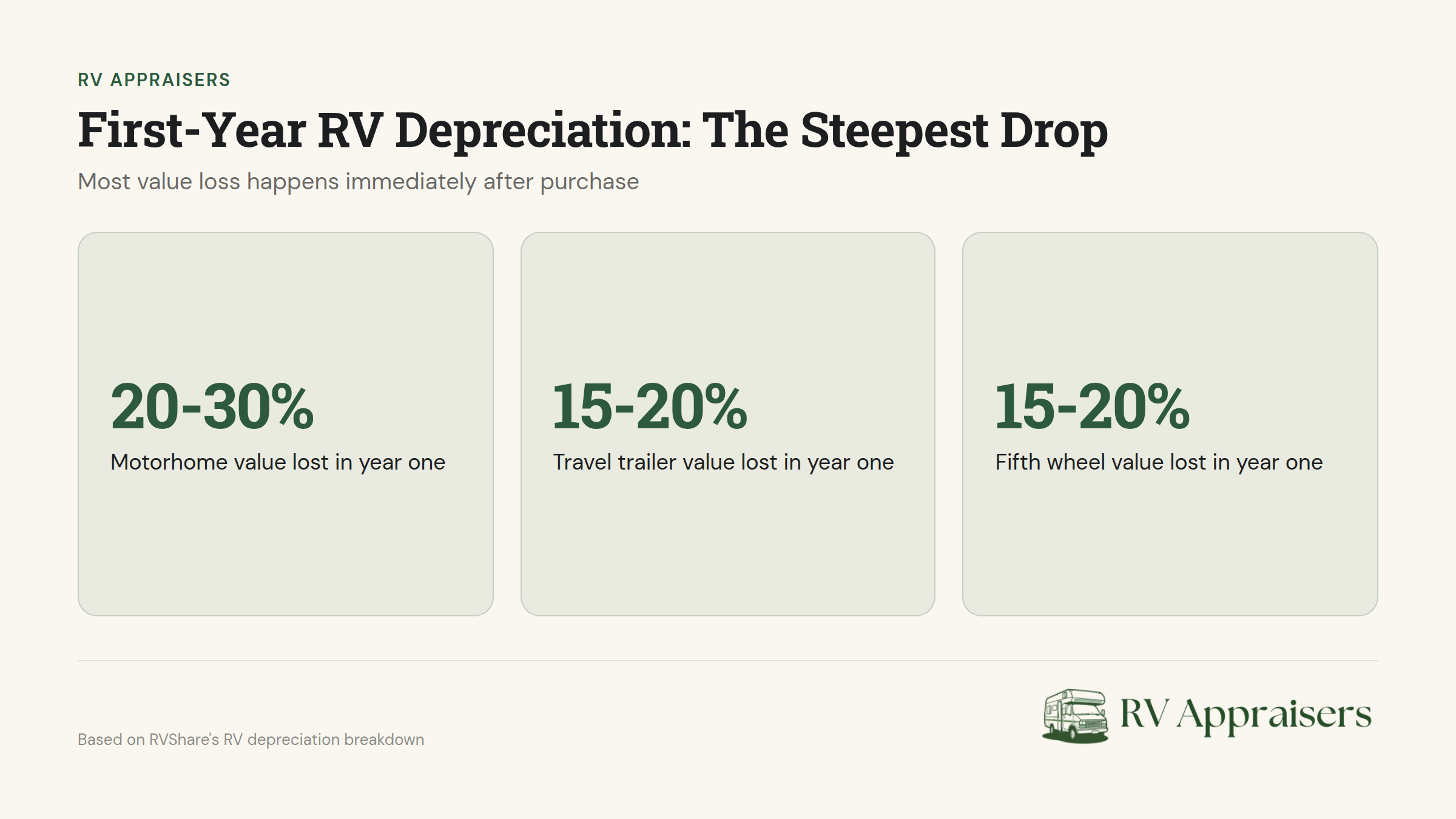
Most of an RV's depreciation happens fast, and it happens early. Industry depreciation data puts first-year losses at roughly 20 to 30 percent for motorhomes, compared to 15 to 20 percent for travel trailers and fifth wheels driven off the lot, according to RVShare's depreciation breakdown.
After that initial hit, the curve flattens. Depreciation in years two through five tends to slow considerably for every class, which is why the used RV market rewards buyers who purchase a 2- or 3-year-old unit instead of new: someone else already absorbed the steepest part of the drop.
Pro tip: If resale value matters to you, buying a lightly used RV that is 1 to 2 years old often delivers a better value-to-price ratio than buying new, since the first-year cliff has already happened.
Motorhomes: Diesel Pushers, Gas Class A/C, and Class B Vans
Motorhomes are not a single depreciation story. Within the category, build quality and drivetrain type create meaningfully different curves.
Diesel pushers, built on heavier-duty chassis with tag axles, tend to hold their percentage value better than gas-powered Class A or Class C units over the same timeframe. That said, diesel units also cost substantially more when new, so a diesel pusher retaining a higher percentage doesn't always mean it retains more dollars than a well-maintained gas unit. Run the math on both the percentage and the absolute dollar figure before assuming diesel is the safer bet.
Class B camper vans have shown surprisingly strong value retention in recent market data, largely because production volume stays lower and demand has remained steady even as other RV segments soften. The catch: the used Class B market is thinner and less liquid than Class A or C, which can mean your asking price holds but your time-to-sell stretches out longer than you'd like.
Watch out: A strong retained percentage doesn't guarantee a fast sale. A niche, low-volume class can hold value on paper while sitting on the market for months waiting for the right buyer.
Travel Trailers and Fifth Wheels: The Towables' Structural Advantage
Among towables, the numbers tell a fairly consistent story. J.D. Power's depreciation data shows travel trailers retaining roughly 60 percent of original value at five years, while fifth wheels sit closer to 55 percent, a decrease of about 45 percent. By year 10, that gap widens further, with fifth wheels falling to around 29 percent retained value, a cumulative 71 percent loss.
RecNation's resale-value analysis puts similar figures in range form: travel trailers commonly retain 40 to 55 percent of value at five years, fifth wheels 40 to 50 percent, and typical Class A motorhomes only 30 to 45 percent over the same span. Across nearly every data set, travel trailers land at or near the top of the mainstream field.
RVLoanWizard's guide to depreciation by type goes further, describing well-built travel trailers as some of the best value-holders in the entire market, with reputable-brand units retaining 55 to 60 percent of value at five years. Fifth wheels aren't far behind on average, but the segment shows more spread: entry-level units depreciate closer to the average fifth-wheel curve, while heavy, luxury fifth wheels can see sharper drops simply because fewer buyers own a tow vehicle capable of hauling them.
That said, average figures don't tell the whole fifth-wheel story. Premium models from well-regarded manufacturers sometimes buck the trend entirely. RV.com has noted that certain fifth wheels, like the Grand Design Reflection 303RLS, have sold consistently above published NADA book values, roughly 10 percent over book in some transactions, making individual models within the fifth-wheel class among the strongest resale performers in the entire RV market. If you're weighing NADA-style guide numbers against what your specific unit might actually bring, our guide on whether RV appraisals are more accurate than NADA guide values walks through why guide books and real transaction values can diverge.
Comparing Depreciation by RV Class at a Glance
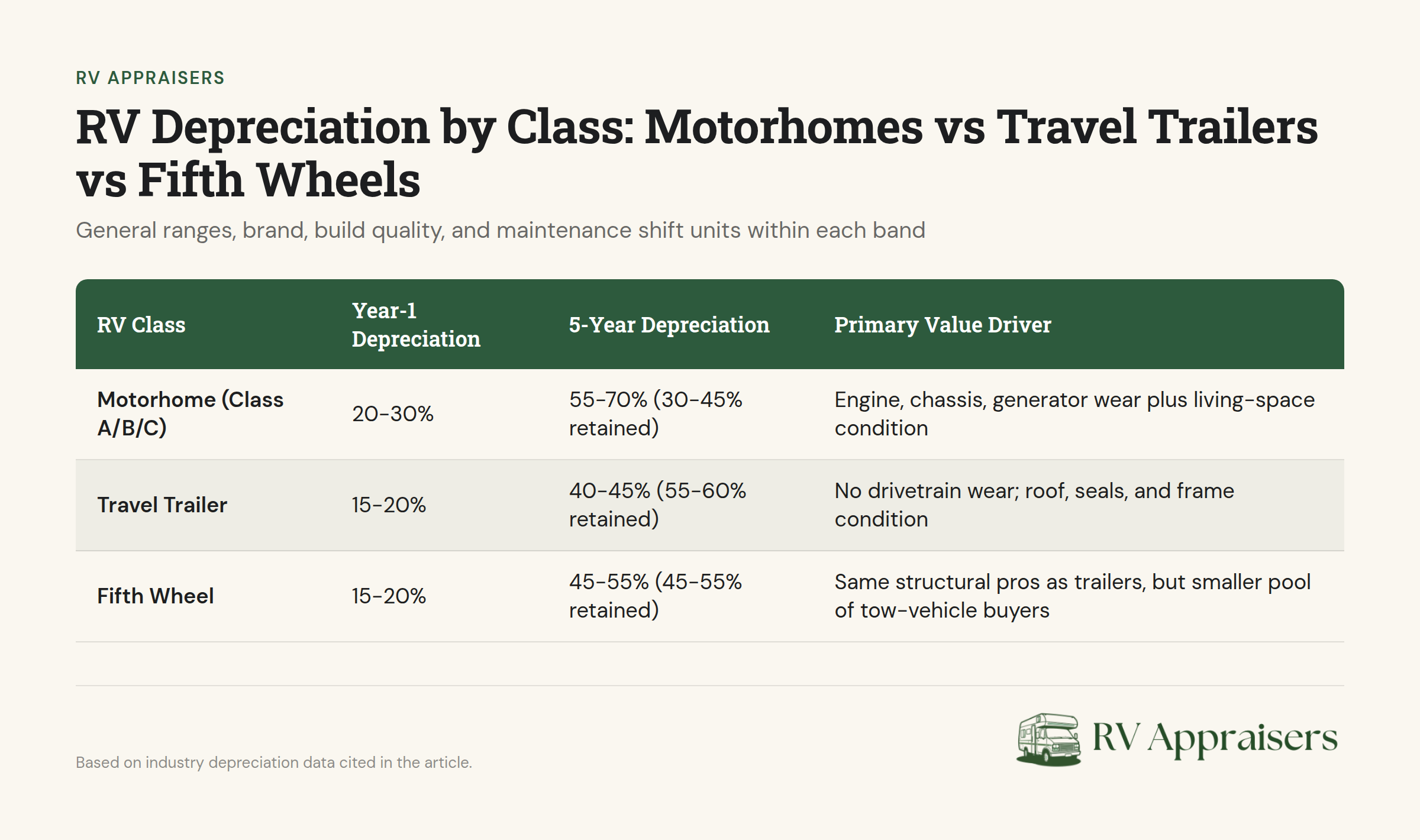
The table below summarizes typical depreciation patterns across the three classes, based on the industry data cited above. Treat these as general ranges: brand, build quality, and maintenance history shift individual units up or down within each band.
| RV Class | Typical Year-1 Depreciation | Typical 5-Year Depreciation | Primary Value Driver |
|---|---|---|---|
| Motorhome (Class A/B/C) | 20-30% | 55-70% (30-45% retained) | Engine, chassis, and generator wear stacked on living-space condition |
| Travel Trailer | 15-20% | 40-45% (55-60% retained) | No drivetrain wear; roof, seals, and frame condition |
| Fifth Wheel | 15-20% | 45-55% (45-55% retained) | Same structural advantages as travel trailers, offset by a smaller pool of qualified tow-vehicle buyers for larger units |
What Actually Drives Resale Value More Than Class
Class matters, but it isn't the strongest lever available to an RV owner. Brand reputation consistently moves resale value more than the difference between, say, a mid-tier travel trailer and a mid-tier fifth wheel. A well-regarded, quality-built brand in either category will outsell and out-price an entry-level or mass-market unit of the same age and class almost every time.
Condition is the second major factor, and it's the one owners control directly. Maintenance records, roof and seal upkeep, and avoiding non-factory modifications protect resale value far more than the class decision made at purchase. A meticulously maintained fifth wheel from a strong brand will often out-resell a neglected travel trailer of the same age, even though travel trailers hold the edge on average.
Key takeaway: Class sets the baseline curve, but brand and condition decide where an individual RV actually lands on that curve. Two identical-class units three years apart in maintenance history can differ by thousands of dollars at resale.
Why a Professional RV Appraisal Matters When Resale Value Is on the Line
Online value guides are a fine starting point, but they price a generic version of your RV, not the one sitting in your driveway with its specific mileage, upgrades, condition, and maintenance history. When real money is riding on the number, a trade-in negotiation, an insurance replacement-cost basis, a private sale, or a loan application where the RV serves as collateral, a generic guide figure can leave money on the table or misrepresent what you actually own.
A professional RV appraisal documents the unit's actual condition, verifies its equipment and modifications, and produces a defensible, USPAP-compliant valuation you can point to in a negotiation or a claim. That distinction matters most exactly when class-level depreciation data (like the ranges above) stops being enough, because your RV isn't an average, it's one specific asset with its own history.
Buying (and Selling) With Resale in Mind
If you're shopping new, the data favors travel trailers for the strongest average value retention, with well-specified fifth wheels close behind and capable of outperforming on a model-by-model basis. Motorhomes cost more to hold onto in percentage terms, largely because of the drivetrain, but a diesel pusher or a well-kept Class B can still retain strong dollar value even if the percentage curve looks steeper on paper.
Whatever class you're in, the class only sets the starting curve. Brand reputation and how well you maintain the unit will do more to protect your resale number than the type of RV badge on the front. When it's time to put a real figure behind what you own, whether for a sale, a loan, an insurance claim, or an estate matter, request an RV appraisal and get a documented value built around your specific unit, not a market average.