
RV Damage Appraiser Guide: Diminished Value and Repair Disputes After a Collision
An RV damage appraiser documents pre-loss value, repair quality, and post-repair loss in value for a repairable motorhome or travel trailer. This guide shows which collision disputes the report supports and which ones belong with your attorney.
Published
Key Takeaways on RV Damage Appraisals and Diminished Value
Here is what owners of a repairable, collision-damaged RV need to know about damage appraisals and diminished value:
- What the work covers: An RV damage appraiser documents the RV's value before the collision, the quality of the repairs, and the value lost after repairs are complete. The report fits claims that stop short of a total loss, such as an RV insurance claim appraisal for a repaired fifth wheel or motorhome.
- How diminished value is measured: RV diminished value equals the RV's value immediately before the damage minus its value after repairs are completed.
- Timing: A final loss-in-value figure requires finished repairs, because repair quality drives the number. Salvage value is the one figure available while the RV is still damaged.
- Law and policy control: State law and policy wording decide whether diminished value is recoverable, and an appraisal clause usually resolves only the amount of a covered loss.
- Deliverable: Trailhead RV Appraisers delivers a formal written report only, typically in about one week, with no informal assessments.
An RV damage appraiser measures what a collision cost an owner beyond the repair invoice. A motorhome or travel trailer that is fully repaired can still sell for less than an identical undamaged unit, and insurers dispute both the repair scope and that lost value. This guide explains how a damage report is built and when it helps. Total-loss ACV disputes are a separate problem, covered in our guide to ACV appraisals for a total loss RV claim.
What Does an RV Damage Appraiser Do After a Collision?
An RV damage appraiser establishes three values for a repairable RV: the pre-loss market value, the condition and completeness of the repairs, and the loss in value that remains after repairs. Each figure comes from market evidence and repair records, not from a flat percentage of the repair bill.
Trailhead RV Appraisers prepares these reports in accordance with USPAP, the standard published by The Appraisal Foundation. Our appraisers hold credentials with leading organizations such as CAGA. They value the RV. They do not assign blame for the collision, and they do not decide coverage.
The report is built around a specific question. The type of value used, market value or replacement value, depends on how the policy is written or the situation at hand. The report states which value it concludes and why.
How Is RV Diminished Value Calculated?
RV diminished value is the pre-damage value of the RV minus its value after repairs are completed. A dollar example: a unit worth $60,000 before the collision and $53,000 after repairs carries a $7,000 loss in value.
Repair quality shapes the result. Better repairs typically mean a lower loss in value, if any exists at all. Buyers often refuse to pay full price for a repaired vehicle regardless of how good the repair is, so the market evidence has to show the discount, not just assume it.
The automobile "17c formula" does not work for RVs. RV values depend on floor plan, installed equipment, condition, scarcity, and structural systems, not on mileage alone. A formula built for sedans produces a number that cannot be tied to RV market evidence.
Published guide values are one input. The RV Dealers Association describes the J.D. Power RV Appraisal Guide as a reference for used trade-in and retail values. A guide value is evidence of market value, not the legal measure of diminished value, so our appraisers pair it with comparable sales and post-repair market evidence.
Industry guidance from Escapees describes diminished value as the reduction in an RV's value after an accident even when repairs are completed, and notes that eligibility varies by state.
Which RV Collision Disputes Does a Damage Appraisal Address?
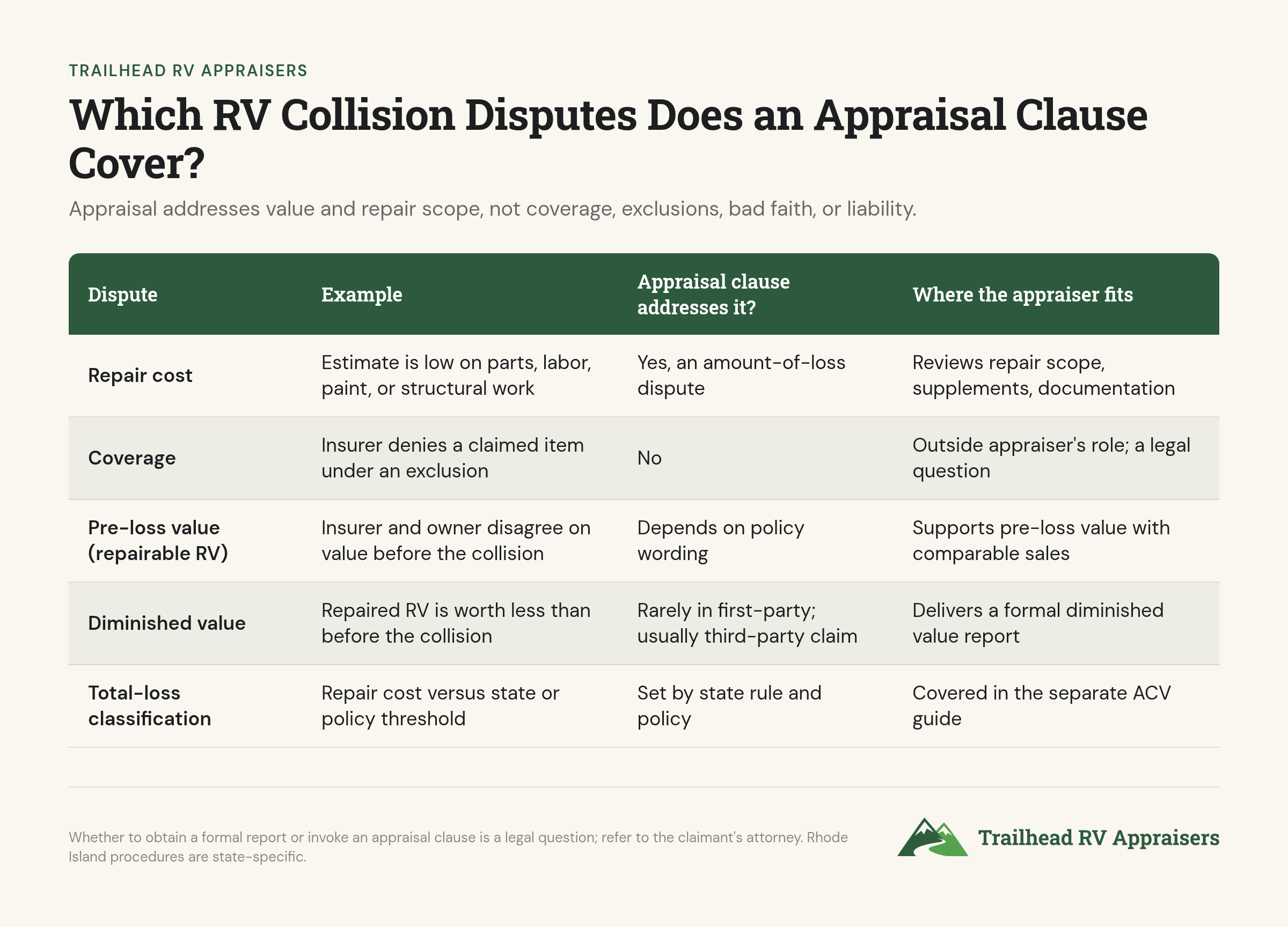
An RV damage appraisal speaks to disputes over value and repair scope. Disputes over coverage, exclusions, bad faith, or liability fall outside an appraiser's role. The table below compares five common disputes and whether a policy's appraisal clause typically addresses each.
| Dispute | Example | Appraisal clause typically addresses it? | Where the RV damage appraiser fits |
|---|---|---|---|
| Repair cost | Estimate is low on parts, labor, paint, or structural work | Yes, this is an amount-of-loss dispute | Reviews repair scope, supplements, and documentation |
| Coverage | Insurer denies a claimed item under an exclusion | No | Outside the appraiser's role; a legal question |
| Pre-loss value of a repairable RV | Insurer and owner disagree on the RV's value before the collision | Depends on policy wording | Supports the pre-loss value with comparable sales |
| Diminished value | Repaired RV is worth less than before the collision | Rarely, in a first-party claim; usually pursued as a third-party claim | Delivers a formal diminished value report |
| Total-loss classification | Repair cost versus the state or policy threshold | Set by state rule and policy | Covered in the separate ACV guide |
An insurance appraisal clause generally resolves disagreements over the amount of a covered loss. Each side picks an appraiser, the two appraisers try to agree, and an umpire decides when they cannot. Two of the three then set the amount.
Rhode Island shows how detailed these procedures become. Under Rhode Island's statute, each side selects a disinterested licensed appraiser, and the insurer's appraiser inspects a vehicle at the repair shop within 4 business days after written demand. When the two proposals differ by 15% or less, the loss is set at their midpoint. These rules are specific to Rhode Island and do not apply elsewhere.
Watch out: Whether to obtain a formal report, and whether an appraisal clause is being invoked, are legal questions. Trailhead RV Appraisers refers both to the claimant's attorney.
What Does an RV Damage Appraiser Document, Step by Step?
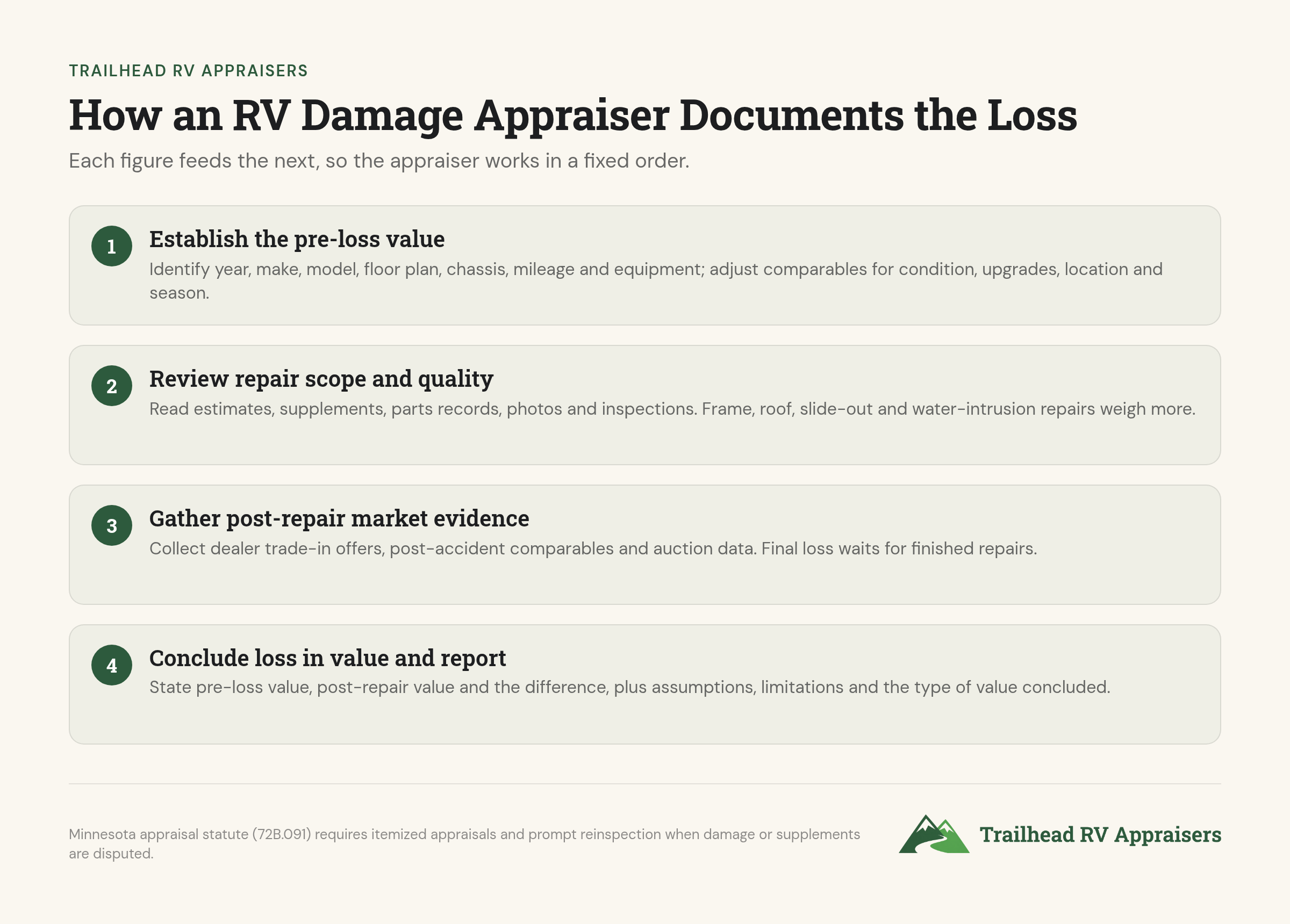
An RV damage appraiser documents the loss in a fixed order, because each figure feeds the next. The process runs as follows:
- Establish the Pre-Loss Value
- The appraiser identifies the exact year, make, model, floor plan, chassis, mileage, and installed equipment.
- Comparable listings and sales are adjusted for condition, upgrades, location, and season.
- Review the Repair Scope and Quality
- The appraiser reads the estimates, supplements, parts records, photographs, and inspection reports.
- Repairs to the frame or chassis, roof, slide-outs, leveling systems, and water-intrusion areas carry more weight than cosmetic work.
- Gather Post-Repair Market Evidence
- The appraiser collects dealer trade-in offers, post-accident comparable listings, and auction data.
- Salvage value can be determined while the RV is still damaged, but the final loss in value waits for finished repairs.
- Conclude the Loss in Value and Deliver the Report
- The report states the pre-loss value, the post-repair value, and the difference between them.
- The report lists its assumptions and limitations and names the type of value concluded.
Minnesota's appraisal statute illustrates why repair documentation matters. It requires an itemized appraisal identifying parts to be repaired or replaced and whether each part is new, used, rebuilt, reconditioned, or replated. It also requires prompt reinspection when a shop requests a supplemental allowance or the extent of damage is disputed.
Pro tip: Photograph the RV before teardown and during repairs, and keep every supplement. Those records let the appraiser separate original damage from work added later.
Example: RV Damage Appraiser Report on a Repaired Fifth Wheel
Example: A 2021 fifth wheel is rear-ended while parked at a campground. The shop's first estimate is $14,200, and a supplement for roof and sidewall work raises the final repair bill to $18,400.
The appraiser builds the pre-loss value from comparable fifth wheels of the same floor plan, adjusted for equipment and condition, and concludes $62,000. After repairs, dealer trade-in offers and post-accident comparable listings support a value of $54,500. The loss in value is $7,500, or about 12% of the pre-loss value.
The figures are illustrative, not a prediction for any claim. The same RV with cosmetic-only damage would show a smaller gap, and a repair touching the frame or a water-intrusion area would show a larger one.
Does State Law Allow an RV Diminished Value Claim?
State law decides whether an RV owner can recover diminished value, and the answer depends on whose insurer pays. A third-party claim against the at-fault driver's insurer is recognized in most states. A few states, such as New York, Massachusetts, and North Dakota, generally do not allow the conventional third-party claim .
A first-party claim under the owner's own collision coverage works differently. The insurer usually owes inherent diminished value only when the policy or state law provides for it. The policy wording and the state statute control in every case, and an attorney is the right person to read them.
The appraiser's role is narrower. Trailhead RV Appraisers supplies a formal, USPAP-compliant valuation of the loss in value. The report does not guarantee any insurer's response or any payout.
Get an RV Damage Appraiser's Formal Report Before You Settle
An RV damage appraiser turns a vague sense that a repaired RV is worth less into a documented figure supported by comparable sales and repair records. The report is useful when the repair is finished, the claim is open, and the dispute concerns value or repair scope rather than coverage or a total loss.
Trailhead RV Appraisers delivers each damage report as a formal written document, typically within about one week. The fee is a fixed fee quoted before work begins, driven by the complexity of the RV, the completeness of your repair records, and the intended use of the report. Fees are never billed hourly. To start, request an RV appraisal and send your repair documents.
This article is provided for general informational purposes only and does not constitute legal, tax, or financial advice. Readers should consult a qualified attorney or CPA regarding their specific circumstances.