
Blog
ACV Appraisal for a Total Loss RV Claim: How to Challenge a Low Payout
When an insurer totals your RV, the ACV appraisal behind the payout often understates your unit's real value. This guide explains how ACV is calculated, why offers run low, and how to use your policy's appraisal clause to fight for a fair settlement.
When an insurance company declares your RV a total loss, the entire settlement hinges on one number: the actual cash value, or ACV, they assign to your unit right before the loss. Get that number wrong, and you're left without enough money to replace what you had. This guide walks through how ACV is supposed to work on an RV claim, where insurer estimates commonly fall short, and how to use the appraisal clause in your policy to push back on a number that doesn't match your rig.
If you're already staring at a settlement offer that feels low, our RV appraisal for insurance claim service exists specifically for this situation: an independent, defensible valuation you can put in front of an adjuster, an umpire, or a court.
What Does ACV Mean for a Totaled RV?
Actual cash value is the cost to replace your RV with a comparable unit of similar age, mileage, and condition, minus depreciation. It is not what you paid for the RV, and it is not what a dealer would charge for a brand-new equivalent model.
Regulators have described ACV in similar terms for years: absent a policy definition that says otherwise, it's generally the lesser of the cost to repair the unit or replace it with substantially identical property, and it should include any sales tax that would apply to that replacement purchase, according to New York's Department of Financial Services. RVs follow the same logic as cars and trucks: age, mileage, wear, and market demand for comparable units all factor into the number.
Most policies calculate a total loss using a formula, not a fixed percentage everywhere. A common industry approach compares repair cost plus salvage value against ACV, and if that sum meets or exceeds ACV, the insurer treats the unit as a total loss rather than paying for repairs, per industry total-loss threshold summaries. Some states set a specific damage-to-value percentage instead. North Carolina, for example, designates a vehicle a total loss once damage reaches 75% or more of its pre-accident actual cash value under North Carolina's administrative code. RV-specific thresholds vary by state and by insurer, so don't assume your state's auto rule applies word for word to your motorhome policy.
How Insurers Calculate ACV on an RV Total Loss Claim
Insurers typically build an ACV figure from comparable sales, published depreciation schedules, and a general condition assessment, then adjust for mileage and age. Industry guidance for RV owners describes the same core method used for cars: current market value minus depreciation, based on comparable units sold in a similar timeframe and region, as described in coverage of RV total-loss valuation practices.
For a Class A motorhome or a heavily optioned travel trailer, that process gets more complicated than it does for a mass-market sedan. Adjusters often rely on desk valuations built from limited comparable data, especially for larger diesel pushers or units with aftermarket upgrades. That gap between a quick desk estimate and the unit's real market position is exactly where a formal ACV appraisal earns its keep, and it's a theme we've covered before when comparing appraised values against guidebook figures.
Pro tip: Before you sign anything, ask your adjuster for the specific comparable listings used to build your ACV offer. If they can't produce them, that's a sign the number was generated from a generic depreciation curve rather than your actual market.
Why Insurer ACV Offers Often Come in Low
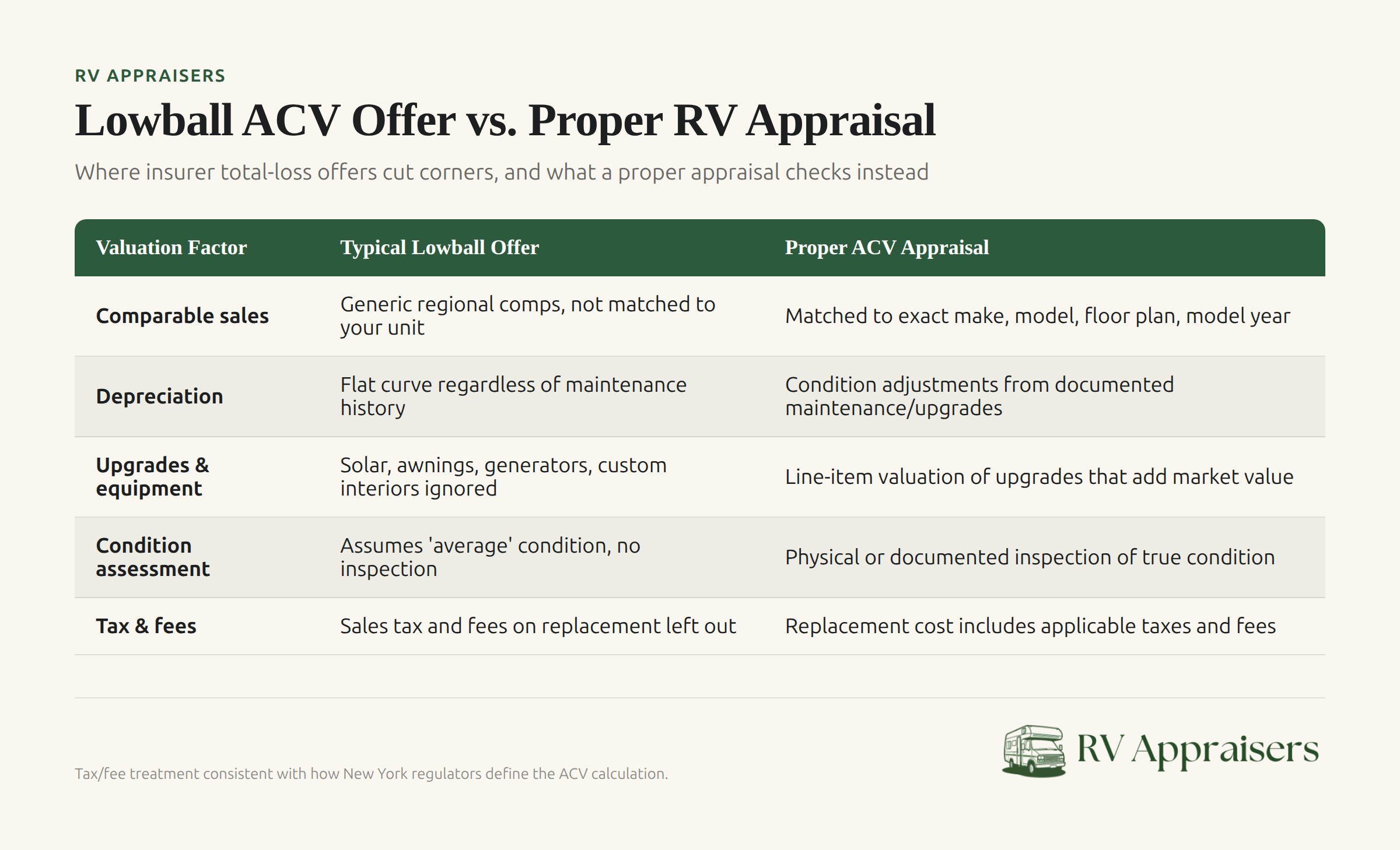
A lowball ACV offer usually isn't the result of bad faith. It's the result of a fast, generalized process that skips details a proper appraisal would catch. The table below shows the pattern we see most often when we're brought in to review a settlement.
| What a Lowball ACV Offer Often Misses | What a Proper ACV Appraisal Accounts For |
|---|---|
| Generic regional comps pulled from a database, not your specific unit's floor plan or trim | Comparable sales matched to your exact make, model, floor plan, and model year |
| A flat depreciation curve applied regardless of actual maintenance history | Condition adjustments based on documented maintenance, upgrades, and inspection findings |
| Factory-installed upgrades and aftermarket additions (solar, awnings, generators, custom interiors) ignored or undervalued | Line-item valuation of upgrades and equipment that add real market value |
| Assumed "average" condition without inspecting the actual unit | Physical or documented inspection establishing the unit's true condition at loss |
| Sales tax and fees on a replacement unit left out of the calculation | Replacement cost figured with applicable taxes and fees included, consistent with how New York regulators define the ACV calculation |
Watch out: If your RV had solar panels, a generator upgrade, custom cabinetry, or a newer awning added after purchase, make sure those are itemized separately in any settlement discussion. Insurers frequently price the base unit and skip the additions entirely.
The Appraisal Clause: How to Challenge a Low ACV Offer
Most RV and auto policies include an appraisal clause: a built-in dispute process that lets you challenge the insurer's ACV number without going straight to litigation. It works like this:
- Notify your insurer, in writing, that you're invoking the appraisal clause. State clearly that you disagree with the ACV figure and want to proceed under the policy's appraisal provision.
- Hire your own appraiser. You select an independent appraiser experienced in RV and motorhome valuation to prepare your own ACV opinion.
- The insurer selects its own appraiser. Each side pays for its own appraiser; this keeps both valuations independent.
- The two appraisers select a neutral umpire. If the appraisers can't agree on the ACV between themselves, they jointly choose a third party, the umpire, to break the tie.
- Agreement of any two parties becomes binding. Once any two of the three (your appraiser, the insurer's appraiser, or the umpire) agree on a value, that figure typically becomes the binding settlement amount under the policy.
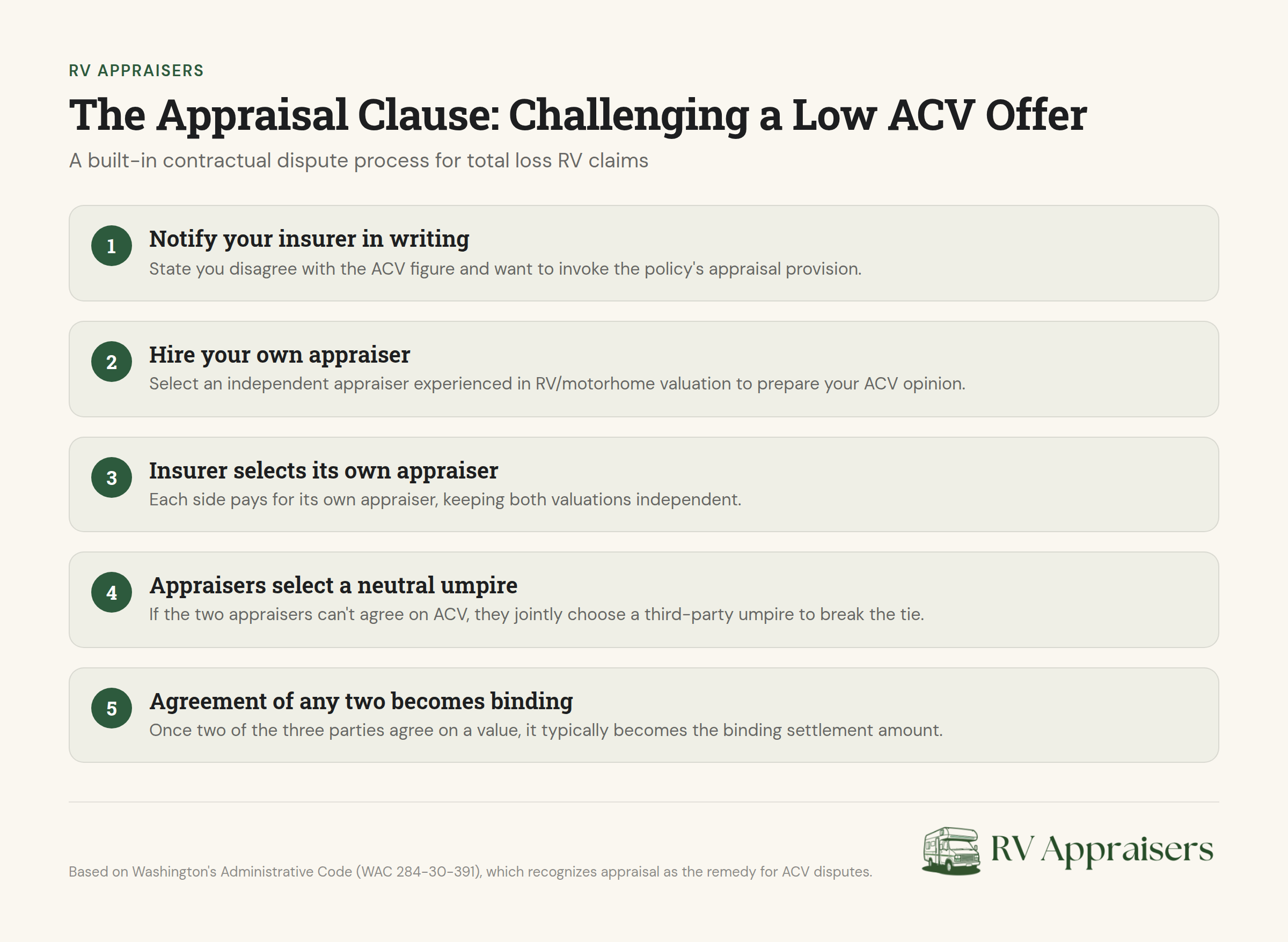
This process exists precisely because ACV disputes are common and rarely require a courtroom to resolve. Washington's insurance code, for example, explicitly recognizes appraisal as the remedy when a policyholder and insurer can't agree on ACV and the policy contains an appraisal provision, per Washington's Administrative Code.
Key takeaway: The appraisal clause is not a lawsuit. It's a contractual dispute mechanism built into most policies, and invoking it doesn't require an attorney, though many owners choose to loop one in for larger claims.
Does Your Policy Have an Appraisal Clause?
Appraisal clauses are common in vehicle and RV insurance policies, but they are not universal, and the specific language varies by insurer and by state. Some states regulate how these clauses must operate; others leave the terms almost entirely to the contract itself.
Before you assume you have this right, check two things:
- Your actual policy document: Look for a section titled "Appraisal," "Loss Settlement," or similar, and read the specific triggering conditions and deadlines.
- Your state's insurance regulations: Some states impose requirements or limits on appraisal provisions for vehicle policies, so the mechanics (who pays for the umpire, how long you have to invoke the clause) can differ from one state to the next.
State rules and policy forms change, so treat any state-specific detail here as a starting point for your own research, not a substitute for reading your policy or asking your agent directly.
How Our Appraisers Support the Appraisal Clause Process
When you invoke an appraisal clause, the appraiser you select is doing real work: inspecting or documenting your unit, researching comparable sales, and defending that valuation opinion if it's questioned by the insurer's appraiser or the umpire. That's the role our team steps into.
We prepare an independent ACV appraisal report for your specific RV, built from comparable sales, condition documentation, and itemized upgrades, and we're prepared to work alongside the insurer's appraiser and, if needed, a neutral umpire to reach a binding resolution. For recreational vehicles, this work is quoted as a fixed fee after we scope the assignment (typical engagements run $195 to $495, with more complex motorcoaches or disputed high-value units running higher), and the fee is set before we begin, never billed hourly.
Getting a Fair Number Before You Sign
An ACV offer on a totaled RV is a starting point for negotiation, not a final word. If the comps look thin, the upgrades are missing, or the condition assumptions don't match your unit, the appraisal clause gives you a structured, contractual way to get a second opinion in front of a neutral decision-maker. Read your policy, document your RV's actual condition and upgrades before you sign anything, and bring in an independent appraisal if the number doesn't add up.
This article is provided for general informational purposes only and does not constitute legal, tax, or financial advice. Insurance policy language and state regulations vary and change; readers should consult their policy documents, their insurance agent, or a qualified attorney regarding their specific claim.