
Blog
Which RV Brands and Types Hold Their Resale Value Best?
Class B camper vans and premium travel trailers like Airstream tend to hold resale value better than large Class A motorhomes, but brand reputation only tells part of the story. This guide breaks down the general depreciation patterns by RV type and explains why a professional appraisal still matters when you sell, insure, or donate.
Every RV owner eventually asks the same question: will this thing be worth anything in five or ten years? The honest answer depends heavily on the type of RV you own, the brand behind it, and how well it has been maintained. Understanding the general resale patterns across motorhomes and towables can help you buy smarter and plan ahead, but when you actually need a defensible number for a sale, an insurance policy, or an IRS filing, a professional RV appraisal carries more weight than any depreciation chart.
Which RV Type Holds Its Value Best?
Across the RV market, Class B camper vans and premium travel trailers consistently hold value better than large Class A motorhomes. Compact size, everyday drivability, and sustained buyer demand keep camper vans in high demand on the used market, while certain travel trailer brands built on distinctive construction and strong brand loyalty (Airstream being the clearest example) can command resale prices well above what a typical trailer of the same age would fetch.
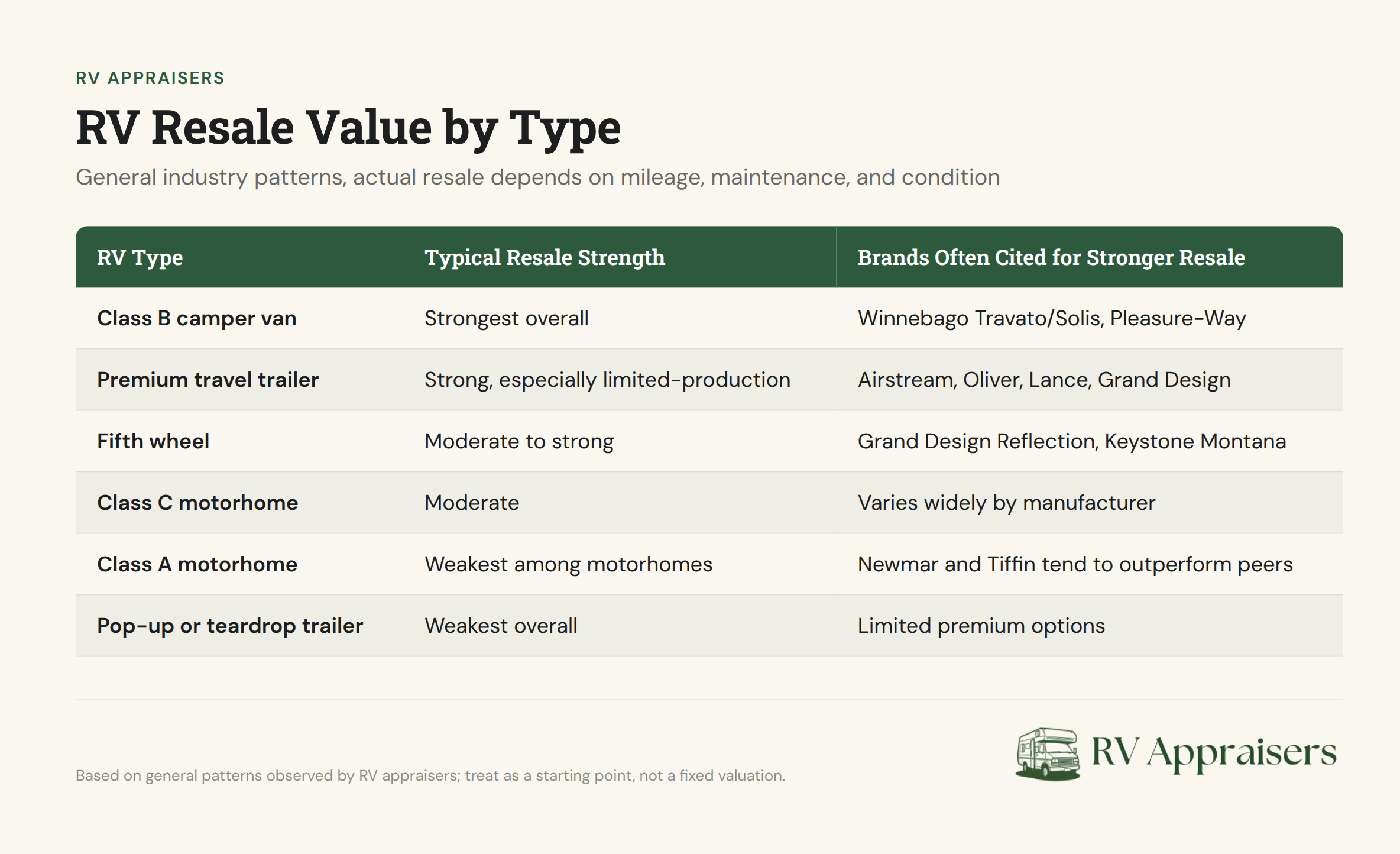
Based on our appraisers' experience valuing recreational vehicles across the country, the general pattern looks like this:
| RV Type | Typical Resale Strength | Brands Often Cited for Stronger Resale |
|---|---|---|
| Class B camper van | Strongest overall | Winnebago Travato/Solis, Pleasure-Way |
| Premium travel trailer | Strong, especially limited-production models | Airstream, Oliver, Lance, Grand Design |
| Fifth wheel | Moderate to strong | Grand Design Reflection, Keystone Montana |
| Class C motorhome | Moderate | Varies widely by manufacturer |
| Class A motorhome | Weakest among motorhomes | Newmar and Tiffin tend to outperform peers |
| Pop-up or teardrop trailer | Weakest overall | Limited premium options |
These rankings reflect general industry patterns rather than fixed percentages. Two RVs of the same make and model year can sell for very different amounts depending on mileage, maintenance history, and cosmetic condition, so treat any published depreciation chart as a starting point, not a verdict.
Why Class B Camper Vans Resist Depreciation
Class B vans hold value well because they solve a problem that larger motorhomes don't: easy daily use. A camper van fits in a standard parking space, doesn't require a special license, and appeals to a much broader buyer pool than a 40-foot diesel pusher. That wider demand pool keeps used prices firmer, and well-known nameplates in this category tend to sell quickly when they come onto the used market in good condition.
Pro tip: If you're shopping for a Class B with resale in mind, prioritize low mileage and complete maintenance records over added features. Buyers of used camper vans pay close attention to engine and chassis history since the living quarters are usually secondary to the drivetrain's condition.
Premium Towables: Why Airstream and Similar Brands Outperform
Airstream is the brand most frequently cited across the RV industry for holding value better than the rest of the travel trailer market. The riveted aluminum shell, decades of continuous production, and a loyal collector base all support resale prices that can remain surprisingly close to original cost even after years of use. Other brands built around limited production runs or distinctive construction, such as Oliver's molded fiberglass trailers and select Grand Design and Lance models, show a similar pattern of stronger-than-average resale performance.
The common thread isn't marketing. It's scarcity combined with a reputation for build quality that used buyers trust without needing to inspect every seam themselves.
Motorhome Brands With Above-Average Resale Reputations
Within the Class A category, where depreciation tends to be steepest, a handful of manufacturers are regularly mentioned as comparatively stronger performers. Newmar and Tiffin both carry reputations for build quality and finish that keep their coaches more competitive on the used market than many mass-market Class A alternatives. Winnebago and Jayco show up repeatedly in industry discussion as well, largely on the strength of broad brand recognition and, in Winnebago's case, a particularly strong reputation in the Class B segment.
None of this means a Newmar or Tiffin coach won't depreciate. It means that among large motorhomes, which depreciate faster than towables or vans as a category, these names tend to depreciate somewhat less aggressively than their peers.
Watch out: Resale reputation by brand is not a guarantee for any individual unit. A well-regarded model with water damage, an accident history, or deferred maintenance can be worth far less than a lesser-known brand that was meticulously cared for.
Why Class A Motorhomes Depreciate Fastest
Class A motorhomes typically lose value faster than any other RV category. They're expensive to begin with, they carry complex chassis and drivetrain systems that intimidate many used buyers, and the pool of people shopping for a 40-foot diesel pusher is simply smaller than the pool shopping for a travel trailer or a compact van. Slide-outs, generators, and hydraulic systems also add maintenance complexity that buyers factor into their offers.
None of this makes a Class A a bad purchase. It just means owners should expect a steeper depreciation curve and plan their insurance coverage and eventual resale expectations accordingly.
What Actually Determines Your RV's Value
Brand and type set the general ceiling, but the number that matters for your specific unit comes down to a handful of concrete factors:
- Mileage and engine hours: Lower use generally supports a higher value, particularly for motorized units.
- Maintenance and service records: Documented upkeep reassures buyers, insurers, and reviewing agencies alike.
- Modifications: Aftermarket changes can help or hurt value depending on quality and buyer preference.
- Water damage and roof condition: These are the two issues that most aggressively erode an RV's value regardless of brand.
- Regional demand: A diesel pusher may command a different price in Florida than in a market with fewer full-time RVers.
A depreciation guide can't account for any of these specifics. That's the gap a professional appraisal is built to close.
Why a Professional Appraisal Matters More Than a Depreciation Chart
A generic guidebook value tells you roughly what a category of RV tends to sell for. It says nothing about your specific unit's condition, upgrades, or history, and it isn't prepared to withstand scrutiny from an insurer, a court, or the IRS. Our appraisers prepare reports in accordance with USPAP (the Uniform Standards of Professional Appraisal Practice) so the concluded value reflects your specific RV at a specific point in time, not an industry average.
That distinction matters in several common situations:
- Insurance coverage: A guide value often understates what it would actually cost to replace a well-equipped RV, which is why owners pursuing an RV appraisal for an insurance claim need documentation tied to the unit itself rather than a generic book figure.
- Estate and donation filings: A qualified appraisal establishes a defensible value for tax documentation, independent of what a resale chart might suggest the unit is worth.
- Private sale negotiations: A written appraisal gives both buyer and seller a neutral, third-party figure to negotiate from, rather than arguing over which online guide is more accurate.
For a personal-use recreational vehicle appraisal, our fees are quoted as a fixed fee before work begins, starting from $195 for a standard report and from $295 for an IRS-qualified report, with typical engagements running $195 to $495 depending on the vehicle and the intended use. More complex assignments, such as high-value coaches or units requiring extensive research, can run higher. You can review the full RV appraisal pricing breakdown before requesting a report.
Key takeaway: Brand and RV type give you a reasonable expectation of how an RV will hold up in the used market over time, but they can't replace a documented, USPAP-compliant appraisal when a real transaction, insurance claim, or tax filing is on the line.
If you're weighing whether to sell, insure, or transfer an RV and want a number that will actually hold up under review, a professional appraisal is a small cost relative to what's riding on getting the value right.