
Blog
RV Loan After Owner Dies: What Heirs and Executors Need to Know About Liens, Probate, and Lender Rights
An RV loan after the owner dies does not disappear: the lender's lien survives and the debt becomes an estate matter. This guide explains who owes what, what lenders can do, and how a date-of-death appraisal helps you decide whether to keep, sell, or surrender the RV.
A financed RV does not become debt-free when its owner dies. The loan becomes a claim against the estate, and the lender's lien stays attached to the vehicle. If you are an heir or the executor, the practical questions are who pays, what the lender can do, and what the RV is actually worth on the date of death.
This guide walks through how an RV loan after the owner dies is handled in probate, where a lender's rights begin and end, and how our team's RV appraisal for probate gives an executor a defensible number to work from.
Key takeaway: The estate inherits the financial problem, not necessarily the family personally. The RV remains collateral, and the lender keeps its enforcement rights if payments stop.
Does an RV Loan Go Away When the Owner Dies?
No. Death does not extinguish the loan or the lien. The unpaid balance is generally paid from the decedent's estate, and the lender keeps its security interest in the RV until the debt is satisfied or the vehicle is sold or surrendered.
Three documents control most of the answers:
- The loan contract: It sets the default terms, any death-related clauses, and whether the lender allows an assumption or refinance.
- The title and lien record: It shows who is on title and which lender holds the lien.
- Any credit life or payment-protection certificate: The CFPB notes that credit insurance can make loan payments if the borrower dies, but only if the borrower actually bought it and the claim meets its terms.
Ordinary RV insurance is a different product. It protects the vehicle against physical loss and liability. It does not pay off the loan because the borrower died.
Who Is Personally Responsible for the Debt?
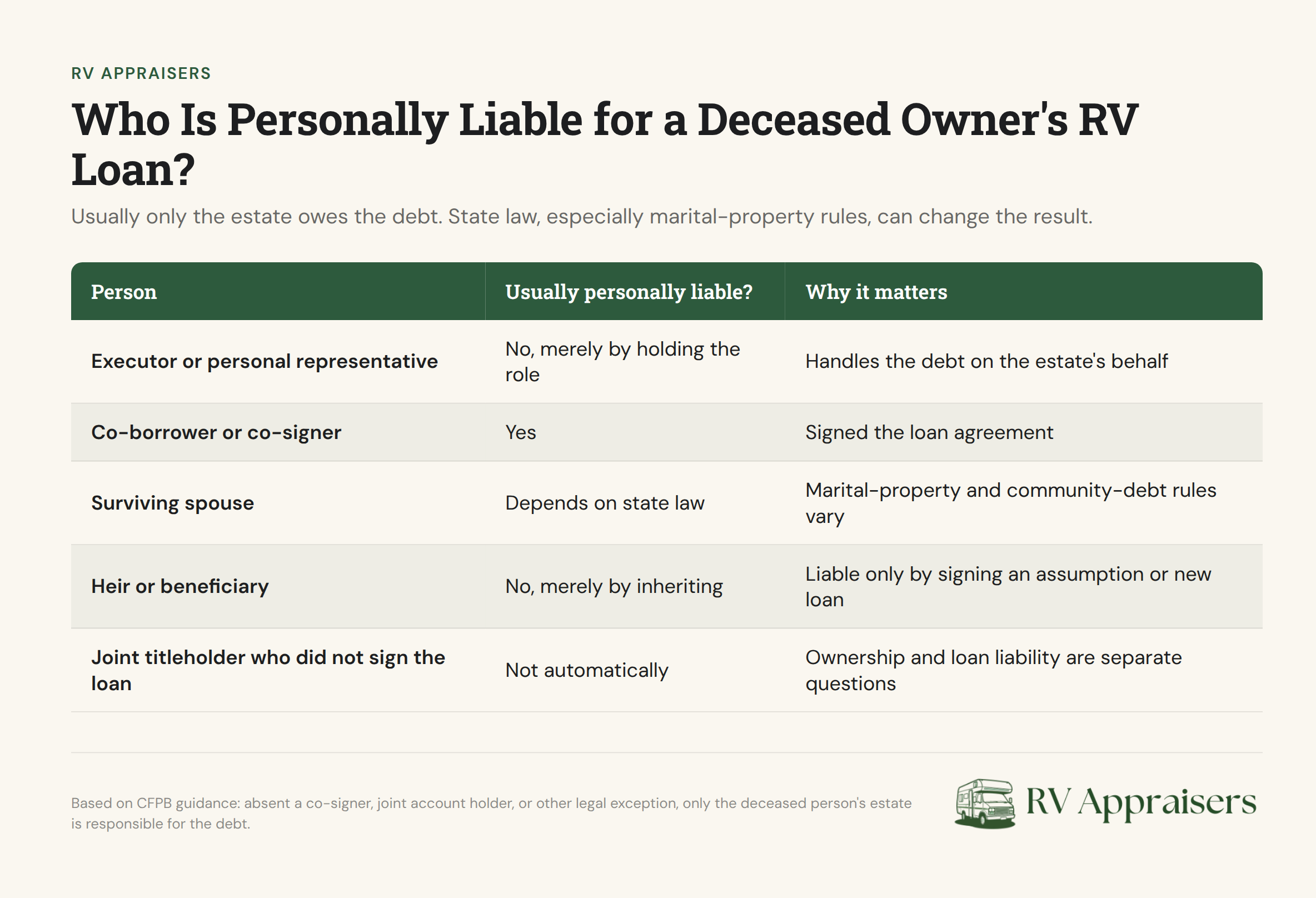
In most cases, only the estate owes the debt. The CFPB explains that, absent a co-signer, joint account holder, or another legal exception, only the deceased person's estate is responsible for the debt. Collectors may contact the executor or a surviving spouse about paying from estate assets, but they should not imply that a relative must pay from personal funds.
The table below summarizes how liability usually works. State law, especially marital-property rules, can change the result.
| Person | Usually personally liable? | Why it matters |
|---|---|---|
| Executor or personal representative | No, merely by holding the role | Handles the debt on the estate's behalf |
| Co-borrower or co-signer | Yes | Signed the loan agreement |
| Surviving spouse | Depends on state law | Marital-property and community-debt rules vary |
| Heir or beneficiary | No, merely by inheriting | Becomes liable only by signing an assumption or new loan |
| Joint titleholder who did not sign the loan | Not automatically | Ownership and loan liability are separate questions |
Example: A widow inherits a $90,000 motorhome with a $62,000 balance. She did not sign the loan. She is not personally liable for it, but if she wants to keep the RV she must pay off the lien, refinance in her own name, or get the lender's approval to assume the loan.
What Can the Lender Do If Payments Stop?
If the loan goes into default, the lender can enforce its security interest in the RV. Under UCC Article 9, a secured party may take possession of collateral after default, either through judicial process or without it, as long as it proceeds without breaching the peace. It may then sell or otherwise dispose of the collateral, provided every aspect of the disposition is commercially reasonable.
That does not mean a lender can seize the RV the day after the funeral. The lender generally has to show a contractual default, such as missed payments or lapsed insurance. It must also follow notice, repossession, and sale rules, which vary by state. The CFPB confirms that consumers have the right to be notified before a repossessed vehicle is sold or retained.
When the sale closes, proceeds are applied in a set order: first the costs of repossession and sale, then the debt, and any surplus goes back to the estate. If the sale falls short, the lender may pursue a deficiency, the gap between what is owed (plus costs) and the sale price.
Watch out: Executors sometimes let the RV be repossessed to "make the problem go away." A low auction price can leave a large deficiency claim against the estate, so ask first whether a negotiated sale will net more.
How Does Probate Treat a Secured RV Lender?
A secured lender and an unsecured creditor are treated differently. Probate generally sets a window for creditors to present claims. The IRS's probate guidance notes that creditor notices commonly set a filing period of about 30 to 90 days, depending on state law. That is not a universal deadline.
In many states, a lender's right to enforce its lien against the RV is not cut off by the ordinary claims deadline. Any unsecured balance, such as a deficiency after a sale, usually has to be presented through the estate's claims process. North Carolina is one illustration: its claims-bar statute is generally read to leave lien enforcement intact, while deficiency claims run against the personal representative. Other states differ, so confirm your state's rules with a probate attorney.
The practical lesson is that missing a claims deadline may not free the RV from the lien, even if it limits what the lender can collect beyond the collateral.
Does the Garn-St Germain Act Protect RV Heirs?
No. The Garn-St Germain Act's protection for transfers to relatives (12 U.S.C. 1701j-3) covers loans secured by residential real property. It does not cover RV or other vehicle loans.
The confusion is common because RVs are homes in the everyday sense. For loan purposes, though, a financed RV is personal property under a security agreement. A lender may, but need not, allow an heir to assume the loan or refinance.
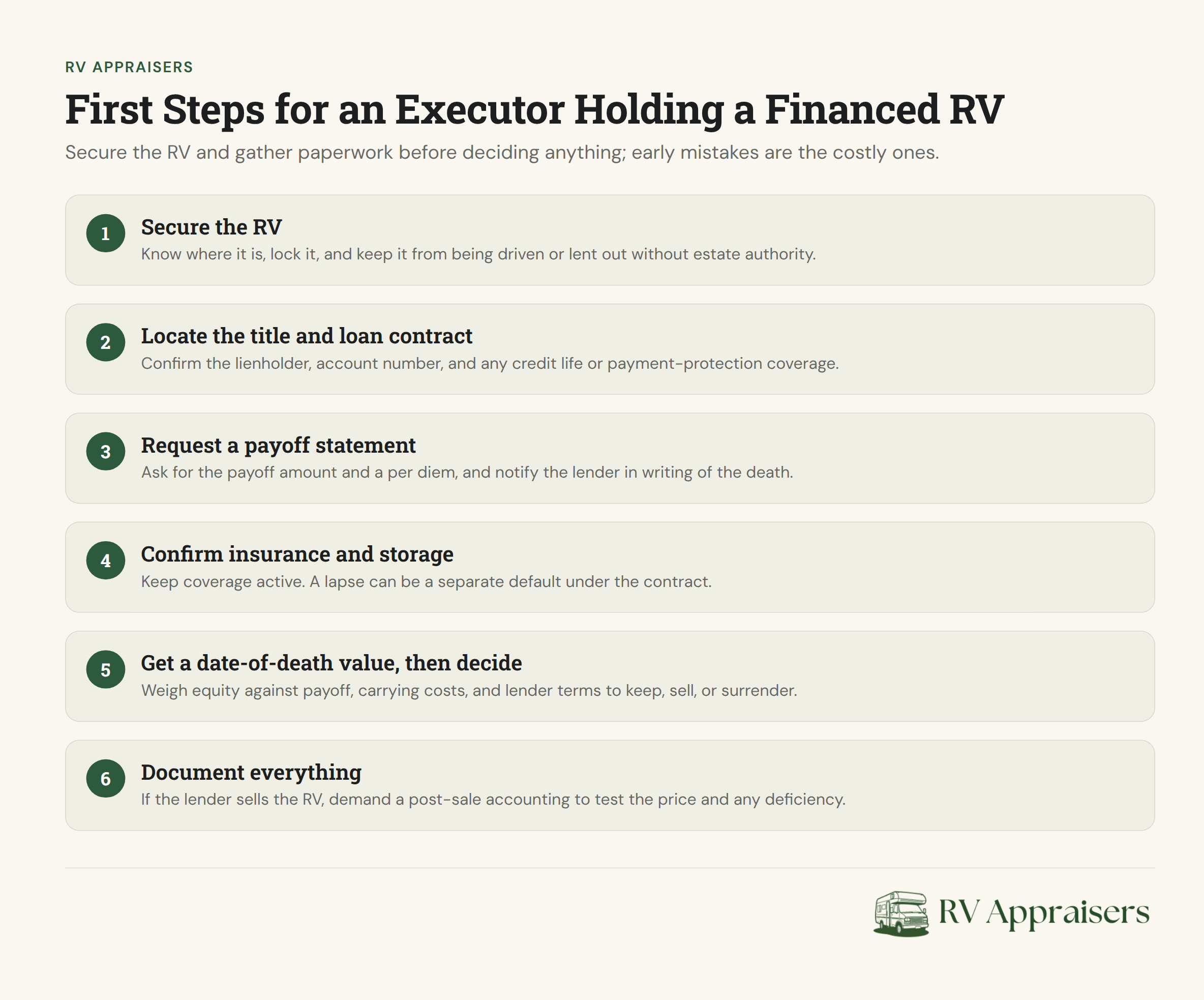
First Steps for an Executor Holding a Financed RV
Secure the RV and gather the paperwork before you decide anything. Most costly mistakes happen in the first few weeks, when payments lapse, insurance expires, or a relative starts using the vehicle without authority.
- Secure the RV
- Know where it is, lock it, and keep it from being driven or lent out without estate authority.
- Locate the title and loan contract
- Confirm the lienholder, the account number, and any credit life or payment-protection coverage.
- Request a payoff statement
- Ask the lender for the payoff amount and a per diem, and notify it in writing of the death.
- Confirm insurance and storage
- Keep coverage active. A lapse can be a separate default under the contract.
- Get a date-of-death value
- You need to know what the RV is worth before you choose a path.
- Decide: keep, sell, or surrender
- Weigh equity against the payoff, carrying costs, and the lender's terms.
- Document everything
- If the lender sells the RV, demand a post-sale accounting so you can test the price and any deficiency.
Keep, Sell, or Surrender: Choosing a Path
The estate generally has four options, and the right one depends on equity. Equity is the RV's value minus the loan payoff.
- Continue the loan: The lender may allow payments to continue from estate funds, but it is not necessarily required to.
- Pay off or refinance: An heir can pay the balance or qualify for a new loan, subject to the lender's underwriting.
- Sell the RV: The lien is paid from the sale. Surplus goes to the estate; a shortfall must be addressed.
- Surrender or allow repossession: The lender sells the RV and applies the proceeds, and a deficiency may remain.
Example: An RV is worth $48,000 on the date of death and the payoff is $41,000. Selling it privately could net the estate roughly $7,000 before costs. If the same RV is surrendered and sold at a $36,000 auction, the estate could face a deficiency of about $5,000 plus fees.
Why the Date-of-Death Value Matters
For probate and federal estate tax, the RV is valued at fair market value on the date of death, not at the purchase price or the loan balance. Treasury Regulation 20.2031-1 defines fair market value as the price a willing buyer and seller would agree on with reasonable knowledge of the facts. If the estate elects the alternate valuation date under IRC 2032, the value is generally measured six months after death, with special rules for property sold in between.
The loan is a separate item. It is a liability of the estate, and the Form 706 instructions say only valid debts owed at death are reported as debts, with liened debts reported as mortgages and liens. Whether the debt is deductible depends on IRC 2053 (bona fide, enforceable claims), and whether a Form 706 is required at all depends on the size of the estate. Our RV appraisal for estate tax work is prepared in accordance with USPAP and IRS requirements for these filings.
A documented value serves two purposes beyond the filing:
- It supports the keep-or-sell decision: You can compare real equity to the payoff instead of guessing.
- It gives you leverage with the lender: If the lender sells the RV, you can compare the sale price to the appraised value when you review the accounting and any deficiency claim.
Because a standard guidebook number is rarely tailored to a specific unit, our appraisers account for mileage, condition, options, and comparable sales. Our appraisers hold credentials with leading organizations such as CAGA, and every report follows the Uniform Standards of Professional Appraisal Practice (USPAP) published by The Appraisal Foundation.
What Does an RV Appraisal for an Estate Cost?
Our fees are fixed and quoted before work begins; we never bill hourly. For a recreational vehicle, a standard appraisal starts at $195 and an IRS-qualified appraisal starts at $295. Most RV assignments fall between $195 and $495, and highly complex units can run $1,800 to $4,500 or more. You can see how scope affects the quote on our pricing page.
Scope drives the fee: the complexity of the unit, how complete the records are, the number of vehicles in the estate, and the intended use. The loan balance and the RV's market value affect the concluded value, not what the appraisal costs.
Settle the RV Question With a Number You Can Defend
An RV loan after the owner dies is an estate problem with a clock on it. Secure the vehicle, get the payoff, keep insurance in force, and learn what the RV is worth before you choose to keep it, sell it, or hand it back. If you are the executor, ask our team for a USPAP-compliant date-of-death RV appraisal so every decision that follows rests on a documented value.
This article is provided for general informational purposes only and does not constitute legal, tax, or financial advice. Readers should consult a qualified attorney or CPA regarding their specific circumstances.