
Blog
How IRS Substantiation Rules Shape Your RV Donation Tax Deduction and Appraisal Needs
An RV donation tax deduction appraisal isn't always required, but IRS substantiation rules decide that for you based on what the charity does with the RV. This guide walks through the dollar thresholds, the fork between gross proceeds and fair market value, and exactly what a qualified appraisal must contain.
Donating a motorhome or travel trailer to a charity sounds simple until tax season arrives and you realize the IRS treats vehicle donations very differently from a bag of clothes dropped at a thrift store. RVs fall under the same substantiation regime as cars, boats, and airplanes: a set of dollar thresholds and paperwork requirements that determine whether you can deduct fair market value, whether you're limited to whatever the charity sold it for, and whether you need a qualified appraisal at all. Getting any one of these wrong can mean losing the deduction entirely, not just shrinking it.
This matters most for owners considering our RV appraisal for IRS charitable donation service, since the appraisal only becomes necessary under specific conditions the IRS spells out in advance. Knowing which path your donation falls into before you hand over the keys can save you from a scramble in April.
Why RV Donations Follow Special Substantiation Rules
For tax purposes, a motorized RV is treated as a "qualified vehicle," the same category that governs donated cars, boats, and airplanes. That classification pulls RV donations into a substantiation and reporting framework built around Form 1098-C and Form 8283, rather than the looser rules that apply to household goods or clothing.
The IRS guidance on vehicle donation rules confirms this framework applies regardless of whether the vehicle is a sedan, a pickup, or a 40-foot diesel pusher. Once you understand that an RV is a "qualified vehicle" in the eyes of the IRS, the rest of the thresholds make more sense.
The $500 Threshold: Form 1098-C and the Written Acknowledgment
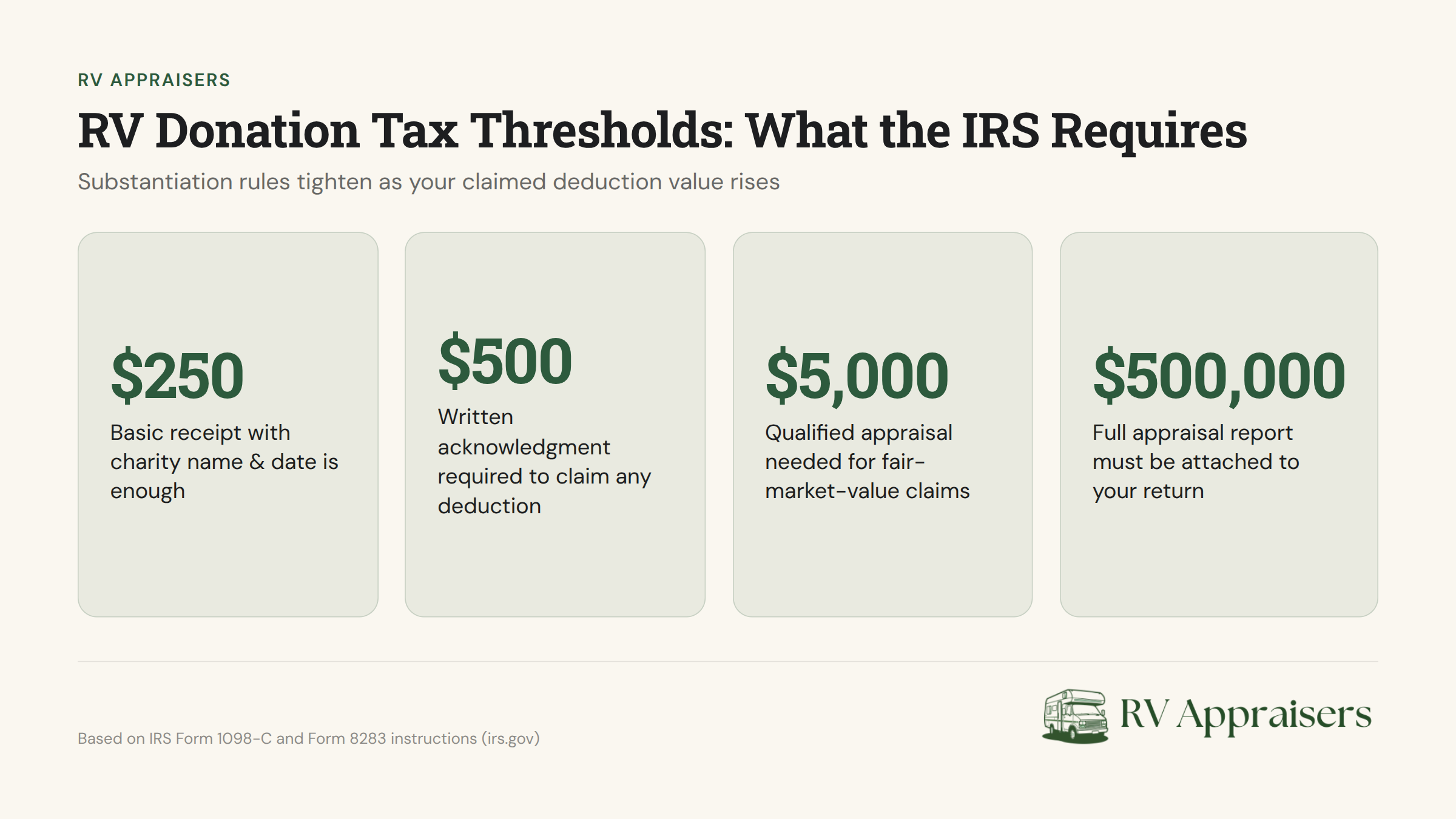
A donated RV claimed at more than $500 cannot be deducted at all unless you attach a contemporaneous written acknowledgment from the charity to your return. Below that line, a simple receipt is generally enough; above it, the paperwork requirement tightens considerably.
Here is how the thresholds actually break down:
- Under $250: A basic receipt showing the charity's name and the date of the gift is sufficient. No vehicle-specific acknowledgment is required.
- $250 to $500: The charity must provide a contemporaneous written acknowledgment describing the RV and stating whether you received anything in return.
- Over $500: You cannot claim any deduction unless you attach a copy of the acknowledgment to Form 8283. Charities typically use Copy B of Form 1098-C to satisfy this requirement, and they must file their own copy with the IRS for any qualified vehicle contribution claimed above $500.
- Over $5,000: A qualified appraisal becomes necessary if your deduction is based on fair market value rather than the charity's sale proceeds (more on that fork below).
- Over $500,000: The full appraisal report, not just Form 8283, must be attached to the return.
"Contemporaneous" has a specific meaning here: the acknowledgment must reach you no later than 30 days after the RV is donated or sold, depending on how the charity disposes of it, per the Form 8283 instructions.
The Fork That Decides Your RV's Deduction Basis
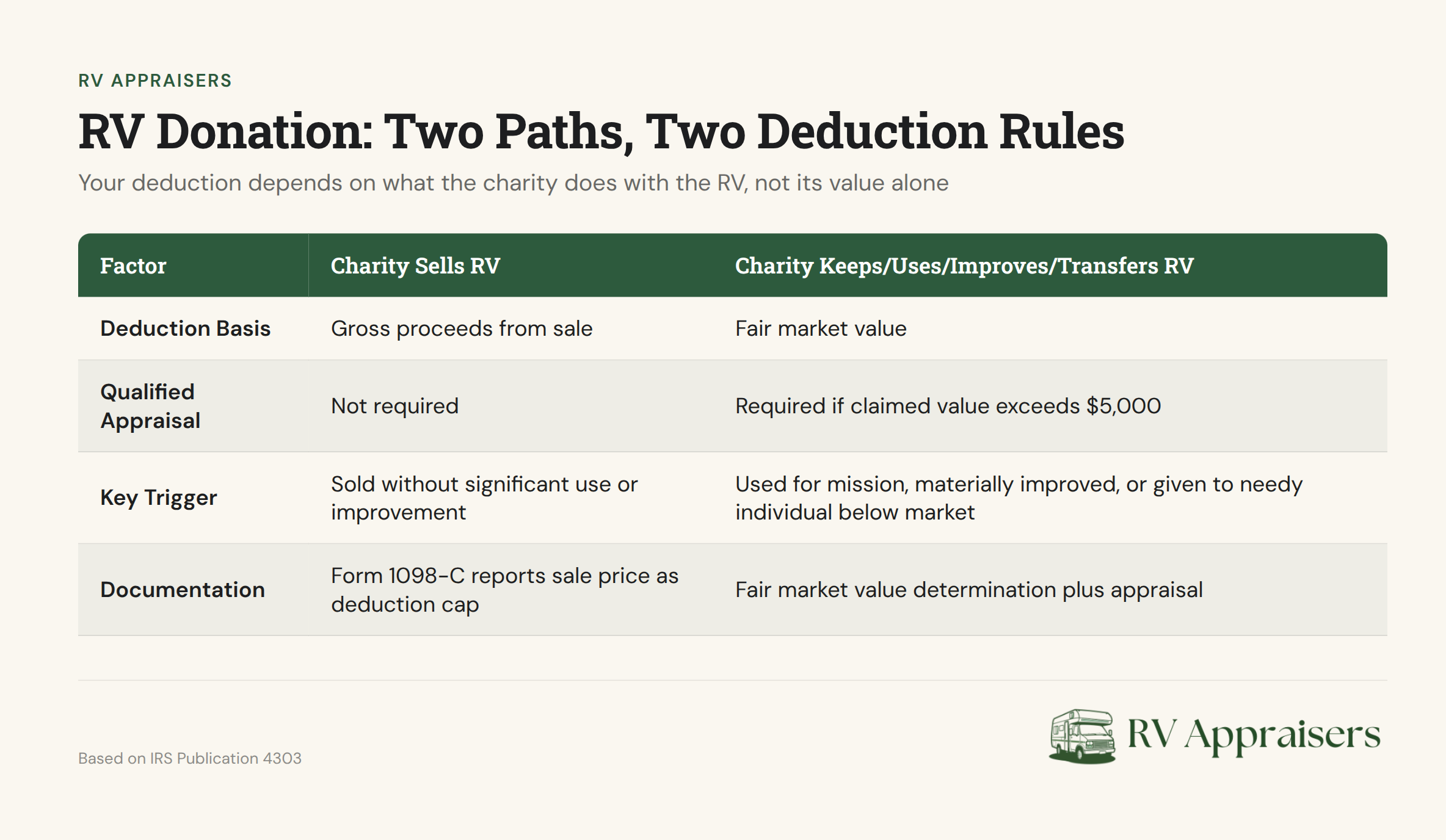
The single most important fact about an RV donation tax deduction appraisal is that it hinges entirely on what the charity does with the RV after you hand it over, not on the RV's value alone. This creates a genuine fork in the road.
If the charity sells the RV without putting it to significant use or making a material improvement first, your deduction is limited to the gross proceeds from that sale. In this scenario, no qualified appraisal is required, even if the sale price is well into five figures. The charity reports the sale price on Form 1098-C, and that figure becomes your deduction ceiling.
If, instead, the charity keeps the RV and uses it for its charitable mission (say, as mobile housing or a training vehicle), materially improves it with substantive repairs, or transfers it to a needy individual at a below-market price as part of its charitable purpose, the calculation flips. In that case, your deduction is based on fair market value, and a qualified appraisal becomes mandatory once the claimed value exceeds $5,000. IRS Publication 4303 lays out this distinction directly, and it's the reason two donors giving away nearly identical motorhomes can end up with completely different documentation obligations.
When a Qualified Appraisal Is Required for Your RV
A qualified appraisal is required whenever your RV donation qualifies for fair market value treatment and the claimed deduction exceeds $5,000. Below that line, or when the charity simply sold the RV, no appraisal is needed regardless of price.
The appraisal itself has to come from a qualified appraiser, someone with recognized credentials and demonstrable experience valuing the specific type of property involved, working in accordance with USPAP (the Uniform Standards of Professional Appraisal Practice, published by The Appraisal Foundation). Our RV appraisers hold credentials with organizations such as the ASA and ISA, and every report we prepare for a charitable contribution is built to satisfy the IRS's qualified appraisal standard rather than a casual value opinion.
Watch out: A dealer quote, an online guidebook printout, or a value estimate from the charity itself does not meet the qualified appraisal standard. The IRS specifically requires an independent appraiser with no financial stake in the outcome.
Because RV appraisal fees are quoted as a fixed fee after we scope the specific motorhome, trailer, or coach involved, pricing depends on the vehicle's complexity and the depth of documentation needed, not on its market value. Our RV appraisal cost guide breaks down how that scoping works, but as a general reference, IRS-qualified RV appraisals typically start from $295, with most falling in the $195 to $495 range and highly complex coaches running higher.
What a Qualified Appraisal Report Must Contain
A qualified appraisal for an RV donation must include enough detail for the IRS to independently verify how the appraiser arrived at fair market value. At minimum, that means a description of the RV specific enough to identify it (make, model, year, VIN), its physical condition at the time of donation, the valuation method used, the effective date of value, and the appraiser's qualifications and signature.
Fair market value itself is defined under federal tax regulations as the price at which property would change hands between a willing buyer and a willing seller, with neither under compulsion and both reasonably informed, a standard explained in detail alongside Publication 561. For an RV, that typically means weighing condition, mileage or engine hours, upgrades, and comparable sales rather than relying on a single guidebook number.
Pro tip: Guidebook values (NADA-style figures) are a useful starting point but rarely reflect the actual condition, modifications, or regional demand for a specific coach. A qualified appraisal has to account for those factors individually, which is part of why the IRS requires one for higher-value donations.
Completing Form 8283 Section B and Appraisal Timing
Once your RV donation crosses the $5,000 fair-market-value threshold, Form 8283 shifts from Section A to Section B, and the paperwork gets more involved. Section B requires the signature of an authorized official at the receiving charity, along with the appraiser's declaration and signature, according to the Form 8283 instructions.
Timing matters as much as the signatures themselves:
- The appraisal must be completed and received by the due date of the return on which you first claim the deduction, including any extensions you've filed.
- The appraisal cannot be dated earlier than 60 days before the date of the contribution. An old valuation from months before you donated the RV won't satisfy the requirement.
- The appraiser must sign Section B of Form 8283, along with the charity's authorized official, before the form is filed with your return.
Missing any one of these deadlines can invalidate the deduction entirely, not just delay it, so it's worth scheduling the appraisal well before you plan to donate rather than after the fact.
Documentation to Gather Before You Donate Your RV
Before you hand over an RV to a charity, gathering the right paperwork up front makes both the donation and any required appraisal go faster. Owners preparing for an RV donation should collect the following:
- The title, showing clear ownership and any liens that need to be resolved before transfer.
- Condition records and photographs, taken close to the donation date, documenting exterior, interior, mechanical systems, and any damage or wear.
- Maintenance history, including service records, tire and battery replacement dates, and any major repairs or upgrades.
- Appliance and system documentation, such as generator hours, slide-out mechanisms, and roof condition, which materially affect value.
- Any Form 1098-C received from the charity, once they've processed the donation and determined how they intend to use or sell the RV.
Having this documentation ready before the appraiser's visit shortens the engagement and gives the report more to work with, which matters if the IRS ever asks questions about the claimed value.
What This Means for Your RV Donation Deduction
The path your RV donation takes through the tax code depends less on the coach itself and more on what the charity does with it after the transfer. A quick resale limits you to sale proceeds and skips the appraisal requirement; a charity that keeps, improves, or redistributes the RV opens the door to a fair-market-value deduction, but only with a qualified appraisal once the value passes $5,000.
Before donating, it's worth asking the charity directly how they intend to use the RV, since that answer determines your documentation path months before your return is due. If a qualified appraisal turns out to be necessary, request an RV appraisal early enough to meet the 60-day and return-due-date windows the IRS enforces.
This article is provided for general informational purposes only and does not constitute legal, tax, or financial advice. Readers should consult a qualified attorney or CPA regarding their specific circumstances.