
Blog
Do You Need a Qualified Appraiser for an RV Donation Over $5,000?
Donating an RV worth more than $5,000 doesn't automatically mean you need a qualified appraiser: for most vehicle donations, the deduction is capped at the charity's sale proceeds instead. This guide explains exactly when IRS rules require a qualified appraisal for an RV donation and what the appraiser's signed declaration must include.
Most donors assume that crossing the $5,000 mark means they need a qualified appraiser, full stop. For ordinary personal property, that assumption is correct. But a donated RV isn't ordinary personal property in the IRS's eyes. It's a "qualified vehicle," and that classification changes the substantiation rules in ways that catch careful donors off guard.
This article stays narrowly focused on one question: when does federal tax law actually require a qualified appraiser for an RV donation, and when does the vehicle-specific rule let you skip one entirely? Our RV appraisal for IRS charitable donation service exists for the donors who do land in qualified-appraisal territory, but a meaningful share of RV donors never need one at all.
The General Rule: $5,000 Triggers a Qualified Appraisal
For most noncash charitable contributions, a claimed deduction over $5,000 requires a written qualified appraisal prepared by a qualified appraiser. This threshold comes from Internal Revenue Code Section 170(f)(11), and the donor must also attach an appraisal summary, Form 8283, Section B, to the tax return.
IRS Publication 561 lays out the valuation framework behind that appraisal: comparable market evidence, the item's condition, the date of contribution, and any restrictions affecting the property. That framework applies to an RV the same way it applies to art or jewelry once an appraisal is actually required. The twist is that for vehicles, a separate rule often overrides this general $5,000 threshold before you ever get to the appraisal question.
What Makes an Appraiser "Qualified" Under IRS Rules
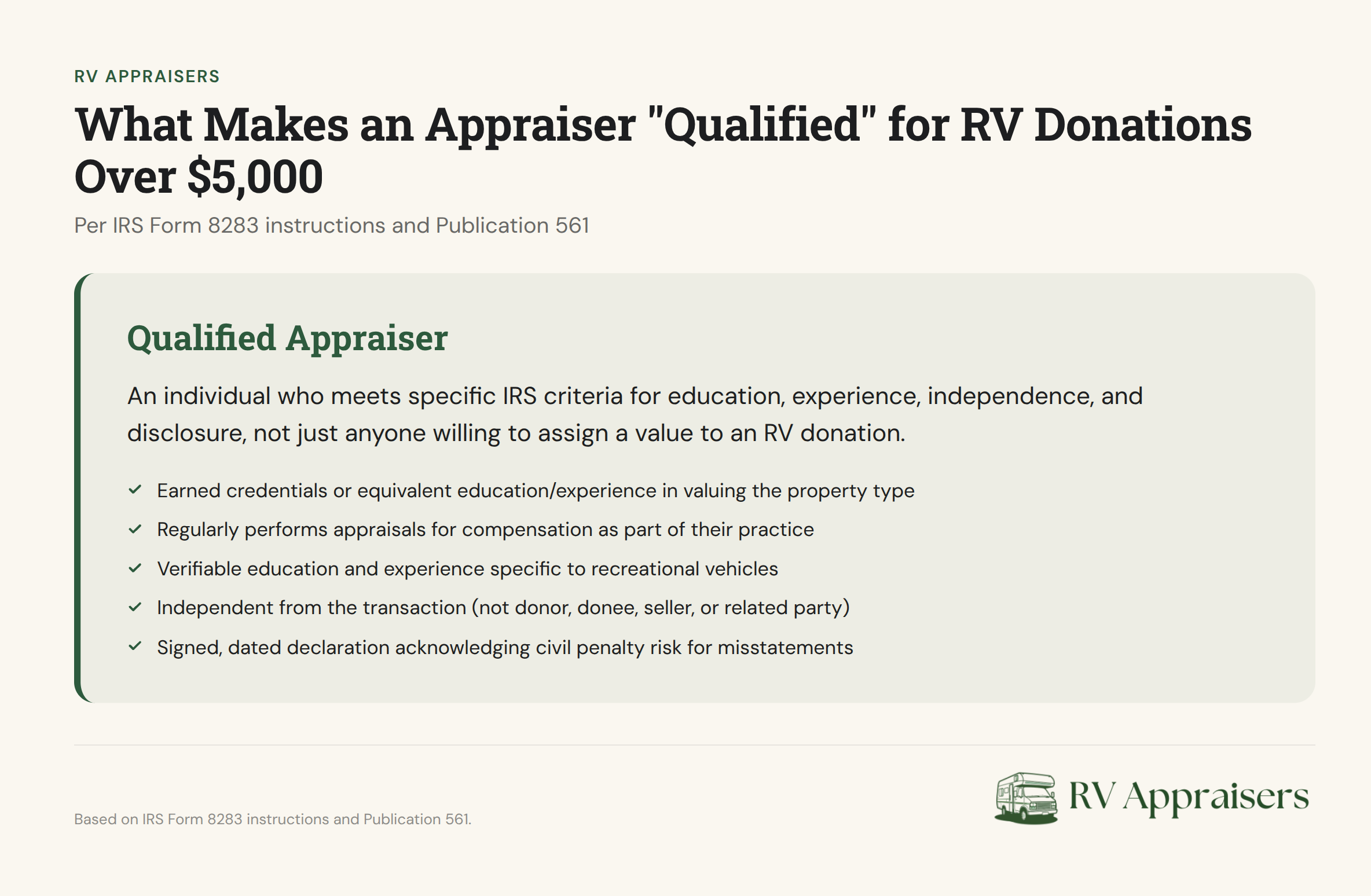
A qualified appraiser is not simply anyone willing to put a number on paper. The IRS sets specific criteria, and the Form 8283 instructions and Publication 561 both describe what the designation requires:
- Earned credentials or equivalent education and experience in valuing the type of property being appraised, not a general business background.
- Regularly performs appraisals for compensation, meaning appraisal work is a genuine part of the appraiser's practice rather than a one-off favor.
- Demonstrated verifiable education and experience in valuing the specific category of property (in this case, recreational vehicles), which is why appraisers who specialize in RVs carry more weight than general property appraisers.
- Independence from the transaction: the appraiser cannot be the donor, the donee, a party who sold the RV to the donor within specified timeframes, or anyone employed by or related to those parties.
- A signed and dated declaration on the appraisal stating the appraiser understands that a substantial or gross valuation misstatement could subject them to a civil penalty, and that they have not been barred from practicing before the IRS.
Neither a professional certificate nor formal membership in an appraisal organization is, by itself, required or sufficient. What matters is whether the appraiser's background and declaration actually satisfy these criteria.
Why Most RV Donations Skip the Appraisal Requirement
Here is the wrinkle that makes RV donations different from furniture, art, or jewelry. Congress built a separate substantiation regime for donated motor vehicles under IRC Section 170(f)(12), and it overrides the ordinary $5,000 appraisal rule in the most common scenario: the charity sells the RV.
When a charity sells a donated vehicle without putting it to significant use or making material improvements, the donor's deduction is capped at the gross proceeds from that sale, not at the RV's fair market value. In that scenario, the donor relies on a contemporaneous written acknowledgment from the charity, typically delivered on Form 1098-C, rather than on a qualified appraisal. The Form 8283 instructions confirm that this acknowledgment, not an appraisal, is what substantiates the deduction when the gross-proceeds cap applies.
Watch out: Donors frequently commission an appraisal before donating an RV, assuming it will support a larger deduction, only to learn that the charity sold the vehicle for less than its appraised value. If the gross-proceeds cap applies, the deduction is limited to what the charity actually received, no matter what the appraisal says.
Gross Proceeds Cap vs. Fair Market Value: Comparing the Two Paths
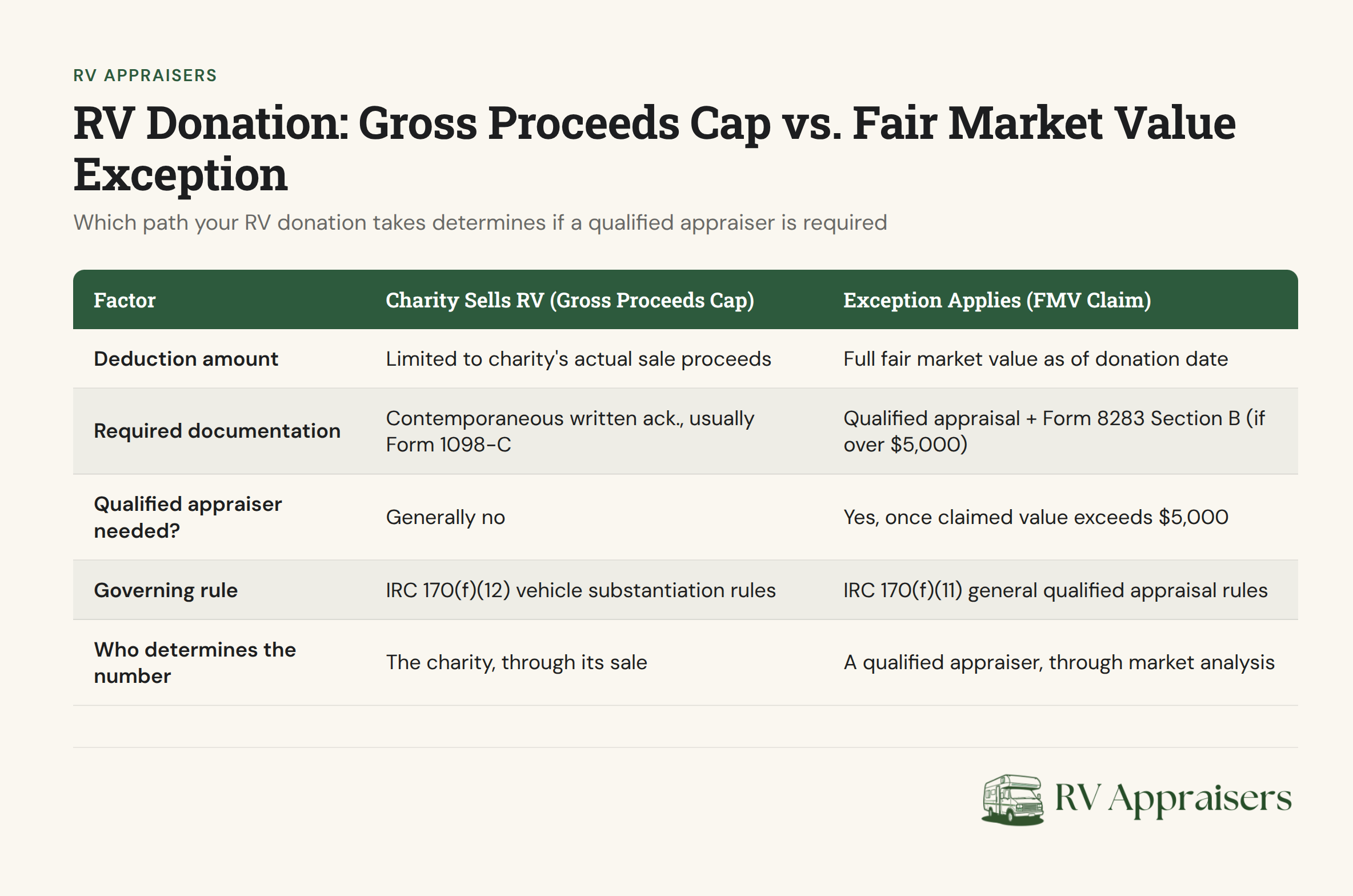
The path your RV donation takes determines whether a qualified appraiser enters the picture at all. The table below contrasts the two scenarios.
| Charity Sells the RV (Gross Proceeds Cap) | Exception Applies (FMV Claim) | |
|---|---|---|
| Deduction amount | Limited to the charity's actual sale proceeds | Full fair market value as of the donation date |
| Required documentation | Contemporaneous written acknowledgment, usually Form 1098-C | Qualified appraisal plus Form 8283, Section B (if claimed value exceeds $5,000) |
| Qualified appraiser needed? | Generally no | Yes, once the claimed value exceeds $5,000 |
| Governing rule | IRC 170(f)(12) vehicle substantiation rules | IRC 170(f)(11) general qualified appraisal rules |
| Who determines the number | The charity, through its sale | A qualified appraiser, through market analysis |
The Three Exceptions That Restore the FMV Claim
The gross-proceeds cap is the default, but it is not absolute. IRS guidance recognizes three situations in which a donor can claim the RV's fair market value instead of the capped sale proceeds:
- Significant intervening use. The charity uses the RV itself, for program purposes such as transporting volunteers or supplies, before selling or disposing of it, rather than simply turning around and selling it.
- Material improvement. The charity makes a substantial repair or improvement to the RV, beyond minor cleaning or cosmetic work, that increases its value before sale.
- Gift or sale to a needy individual at below fair market value. The charity transfers the RV, for free or at a significantly reduced price, to an individual in need, in direct furtherance of the charity's exempt purpose.
This guidance originates from the IRS's vehicle-donation substantiation rules, issued to clarify how the gross-proceeds cap interacts with these exceptions. When one of these three situations applies, the gross-proceeds cap no longer governs, and the donor's deduction can be based on the RV's fair market value as of the contribution date.
This is where the general qualified-appraisal rule comes back into play. Once the exception applies and the claimed value exceeds $5,000, the donor again needs a qualified appraisal from a qualified appraiser, along with the completed appraisal summary on Form 8283, Section B. The charity's written acknowledgment must also describe which exception applies and, where relevant, detail the use or improvement made.
Pro tip: If you suspect your intended recipient charity might use the RV for its own programs rather than sell it immediately, confirm that intention in writing before you donate. It changes your documentation requirements from day one.
What the Appraiser's Declaration Must Include
When a qualified appraisal is required (whether for an RV subject to one of the three exceptions, or for any other property claimed above $5,000), the written appraisal itself must contain specific elements. The Form 8283 instructions and Publication 561 require the document to include:
- A description of the property detailed enough to identify the specific RV: year, make, model, VIN, mileage, condition, and any modifications or aftermarket equipment.
- The date (or expected date) of contribution and the date of the appraisal itself, which generally cannot be made earlier than 60 days before the contribution.
- The appraised fair market value and the valuation method and specific basis used to reach that figure.
- The appraiser's qualifications, including background, experience, and any relevant credentials.
- A statement that the appraisal was prepared for income tax purposes.
- The signed and dated declaration described earlier, acknowledging the penalties for a substantial valuation misstatement.
A qualified appraisal is not a form you fill out casually. It is a defensible, standards-based document, and the appraiser's declaration is what gives the IRS confidence the number behind it wasn't simply a guess.
Getting the Right Documentation From the Start
For the exceptions above, where a charity intends to keep and use the RV or make a material improvement before transferring it, our RV appraisal for IRS charitable donation service produces the IRS-qualified appraisal needed to support a fair-market-value claim over $5,000. We also cover how aggregation and broader substantiation rules apply to RV donations in a separate deep dive on IRS donation rules, which this article intentionally does not repeat.
IRS-qualified RV appraisals are quoted as a fixed fee from $295, scoped to the vehicle and the intended use of the report, and set before any work begins. If your charity has confirmed it will sell the RV without using or improving it, you likely don't need an appraisal at all; the acknowledgment from the sale will carry the deduction instead.
Getting this distinction right matters more than most donors realize. Paying for an appraisal you don't need wastes money, and skipping one you do need can mean losing the deduction altogether. Confirm which path your donation falls into before you file.
This article is provided for general informational purposes only and does not constitute legal, tax, or financial advice. Readers should consult a qualified attorney or CPA regarding their specific circumstances.