
Blog
North Carolina RV Title Bond Appraisals: Why You May Need Two Dealer Reports
A North Carolina RV title bond appraisal often requires two separate dealer reports, not one, when the RV isn't listed in the DMV's Value Schedule. Here's how that two-appraisal rule works, how the bond amount gets calculated, and where an independent valuation fits into the file.
If you're trying to register a recreational vehicle in North Carolina and you can't produce the original certificate of title, the state's bonded title process is probably the path forward. Most owners assume a bonded title works the same way everywhere: get one appraisal, post a bond, done. North Carolina handles it differently for RVs, and the difference can catch owners off guard partway through the process.
Our team prepares independent valuations that support North Carolina RV appraisals for owners navigating this exact situation, and we regularly field questions about why the DMV is asking for two dealer letters instead of one report. This article walks through the rule, the math behind the bond amount, and where a third-party valuation actually helps your file.
What Is a North Carolina Bonded Title?
A bonded title, also called a surety title, lets the DMV issue a title when an owner cannot produce the original certificate, whether it was lost, never issued, or otherwise unavailable. The process is authorized under North Carolina's motor vehicle title statutes and administered through DMV's special-cases procedures, which require the applicant to establish the vehicle's value, obtain a surety bond, and submit specific forms before a title is issued (NCDOT DMV special cases guidance). The bond protects any prior owner, lienholder, or later purchaser who might come forward with a competing claim after the new title is issued.
The process isn't unique to RVs. Cars, trucks, trailers, and mobile homes can all go through it. What changes by vehicle type is how the DMV decides what the vehicle is worth, and that's where RV owners run into an extra step.
How NC DMV Normally Values a Vehicle for a Bonded Title
For most ordinary vehicles, the DMV sets the value itself using its own current Value Schedule. No outside appraisal is required because the schedule already contains a figure for that make, model, and year.
RVs frequently fall outside that schedule. Specialty conversions, older coach models, less common manufacturers, and many travel trailers simply don't have a matching line item. When a vehicle isn't listed, the DMV can't pull a number from its own table, so it shifts the burden of establishing value onto the applicant.
Why RVs Often Require Two Separate Dealer Appraisals
When a vehicle, including a mobile home or an RV not listed in the Value Schedule, requires outside valuation, DMV instructions require two appraisals rather than one. Both must come from different North Carolina vehicle dealers, both must be written on dealer letterhead, and both are submitted together with the indemnity bond application, per the DMV's instructions for Form MVR-92A (Requirements/Instructions for Obtaining Title by Filing an Indemnity Bond).
This is a dealer-specific requirement. The instructions call for appraisals from licensed North Carolina dealers, not from a generic appraiser of any kind. That detail matters because it means an independent fair market value report, however thorough, does not substitute for either of the two required dealer letters.
Watch out: Owners sometimes assume a single professional appraisal will satisfy the DMV's requirement for an unlisted RV. For vehicles outside the Value Schedule, the published instructions call for two dealer letters, not one appraisal from any source.
How the 1.5x Bond Multiplier Works
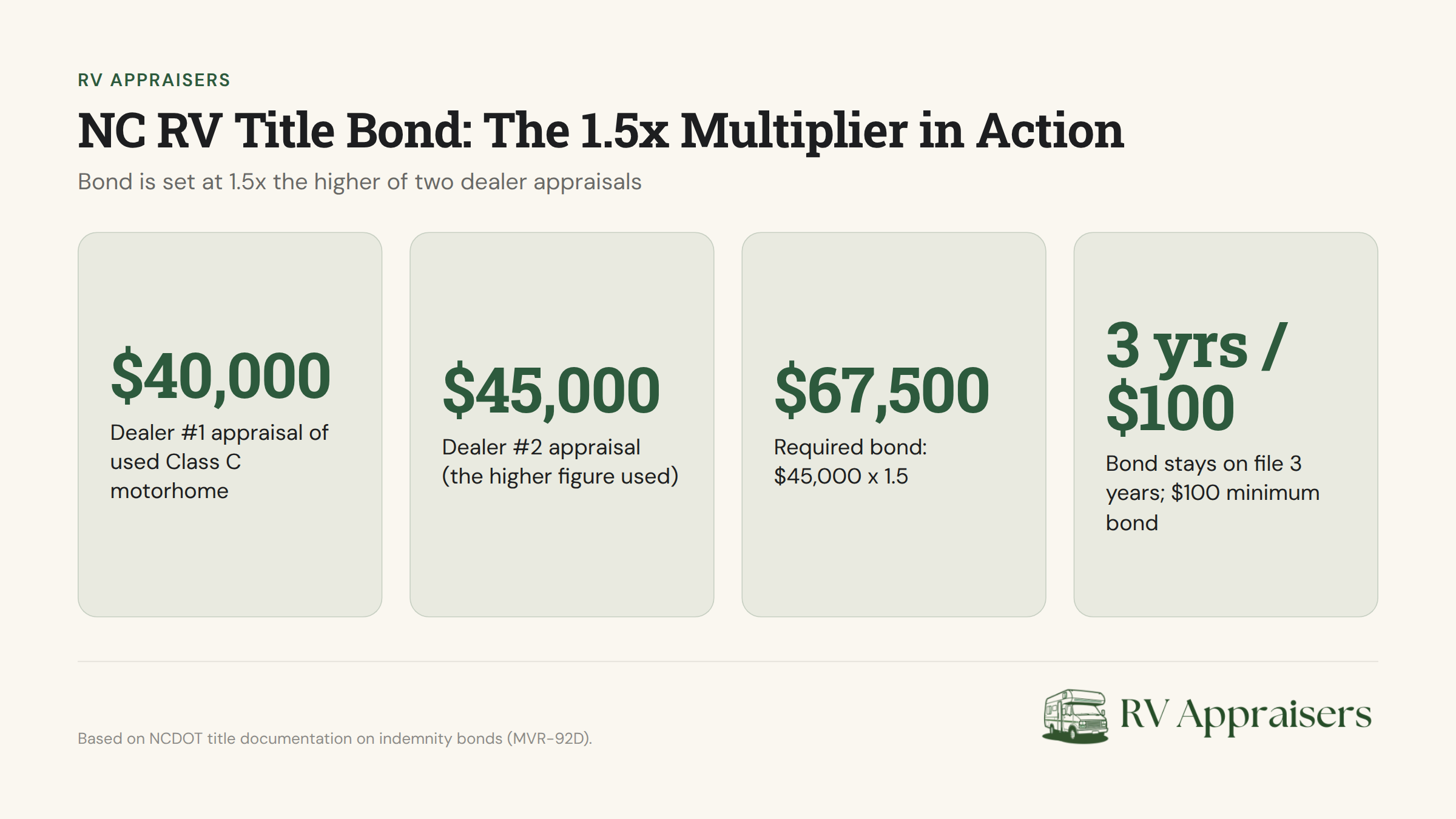
Once both dealer appraisals are in hand, the DMV doesn't average them or use the lower figure. The surety bond is set at one and one-half times the higher of the two appraisals, a calculation spelled out in DMV's title documentation on indemnity bonds (NCDOT MVR-92D).
Example: Say one North Carolina dealer appraises a used Class C motorhome at $40,000 and a second dealer appraises it at $45,000. The bond amount is calculated against the higher figure: $45,000 x 1.5, for a required bond of $67,500.
That's a meaningful swing based on which two dealers you happen to use, since a $5,000 gap between appraisals translates into a $7,500 difference in the bond amount. DMV's published instructions set a $100 minimum bond and specify that the bond stays on file for 3 years.
What the Two Dealer Appraisals Must Include
DMV's instructions are specific about format, not just content. Each appraisal needs to:
- Come from a North Carolina-licensed vehicle dealer, not an individual appraiser or out-of-state dealer.
- Be printed on that dealer's letterhead, identifying the dealership by name.
- Be submitted alongside the completed indemnity bond paperwork, including the accompanying affidavit of facts.
- Reflect a value independently arrived at by each dealer, since the two reports are meant to check each other.
The process also typically involves a vehicle inspection by the State Highway Patrol's Investigative Services Unit before the title can move forward, along with applicable taxes, fees, and any required emissions or safety inspections.
Where an Independent RV Appraisal Fits Into the File
An independent, USPAP-compliant fair market value report from our appraisers is not one of the two dealer letters North Carolina requires for an unlisted RV, and we don't present it that way. What it does provide is additional, third-party value evidence that can strengthen the file in a few specific situations:
- The two dealer appraisals conflict significantly. A surety company or bonding agent may want a neutral third opinion to help make sense of the gap before issuing the bond.
- A lienholder or prior owner disputes the value used. An independent report gives the file a documented, methodology-based valuation rather than relying solely on two dealer opinions.
- You need a defensible value for insurance or financing on the same RV. Many owners going through a bonded title process also need to insure or finance the vehicle shortly after, and a separate appraisal serves both purposes.
Our appraisers hold credentials with organizations such as ASA and ISA, and every report follows USPAP guidelines regardless of asset type. For an unlisted RV going through North Carolina's bonded title process, think of our report as supporting documentation alongside the two required dealer appraisals, not a replacement for either one. Fees for a standalone recreational vehicle appraisal are quoted as a fixed fee before work begins, and our recreational vehicle pricing starts at $195 for a standard report.
How North Carolina Compares to Other States
Many states accept a single independent fair market value appraisal to support a bonded title application. North Carolina's two-dealer-appraisal structure for unlisted vehicles, paired with the 1.5x bond multiplier, is a less common approach.
| State | Appraisal Requirement for Bonded Title |
|---|---|
| North Carolina | Two appraisals from different NC dealers (for vehicles not in the Value Schedule), on dealer letterhead; bond set at 1.5x the higher figure |
| Most states | A single independent fair market value appraisal, often from any qualified appraiser |
| Alaska, Texas | Require an in-person appraisal as part of the bonded title process |
| Delaware | Requires the appraisal to come from a licensed Delaware dealer |
| Illinois | Requires the value to come from a licensed vehicle dealer |
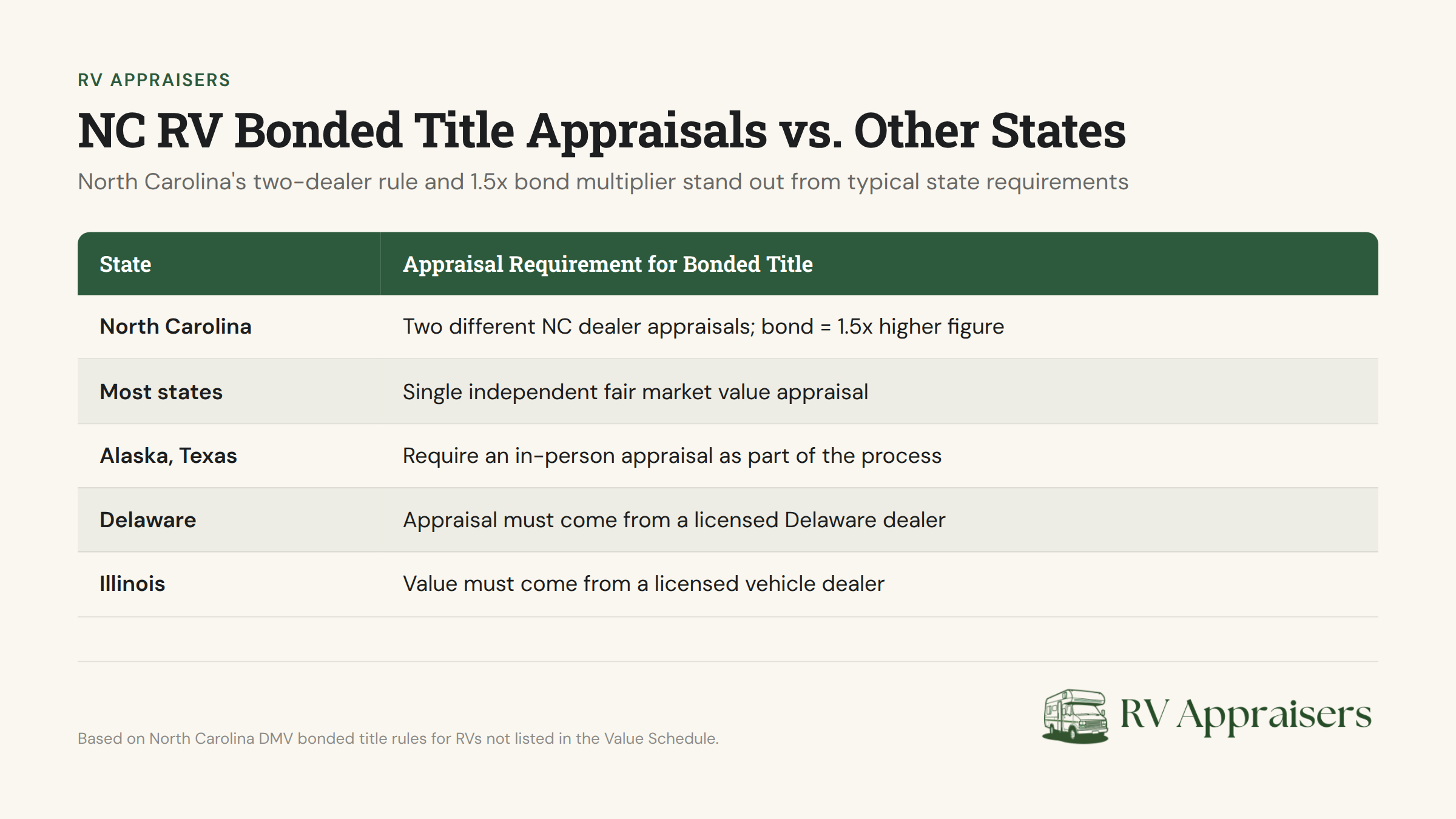
The practical takeaway is that North Carolina RV owners can't assume what worked for a friend's bonded title in another state will work here. If your RV isn't in the DMV's Value Schedule, budget time to get two dealer appraisals lined up, and consider whether an independent report would help if the two dealer figures land far apart.
Getting Your Bonded Title File in Order
North Carolina's bonded title process for an unlisted RV moves faster when you understand the sequence up front: confirm whether your RV appears in the Value Schedule, line up two North Carolina dealer appraisals if it doesn't, and calculate your bond at 1.5 times the higher figure before you approach a surety company. If a surety agent, lienholder, or insurer wants additional value evidence beyond the two dealer letters, our team can prepare an independent, USPAP-compliant valuation to support that part of your file. Request an RV appraisal to get a fixed-fee quote for your bonded title documentation.
This article is provided for general informational purposes only and does not constitute legal, tax, or financial advice. Readers should consult the North Carolina DMV or a qualified attorney regarding their specific circumstances.