
Blog
Motorcoach Appraisal for Class A Diesel Pushers: A Complete Owner's Guide
A motorcoach appraisal establishes a defensible fair market value for a Class A diesel pusher, backed by chassis, drivetrain, and condition data rather than a generic pricing guide. This guide covers when owners need one and exactly what shapes the number.
A Class A diesel pusher is not the same asset as a travel trailer, and it shouldn't be valued like one. It's a self-propelled motorcoach built on a heavy-duty chassis with a rear-mounted diesel engine, and its value is driven by mechanical, structural, and market factors that a generic pricing guide simply doesn't capture. This guide walks through what a motorcoach is, when owners actually need a professional appraisal, what shapes the number, and how the appraisal process works from start to finish.
What Is a Motorcoach?
A motorcoach is a motorized recreational vehicle, meaning the living quarters and the drivetrain are built into a single unit rather than towed behind a separate vehicle. Class A diesel pushers sit at the top of that category: they're built on commercial-grade or purpose-built chassis (Freightliner and Spartan are common examples), with the diesel engine mounted at the rear rather than under a front hood.
That distinction matters for appraisal purposes. A towable travel trailer has no engine, no drivetrain, and no chassis-specific depreciation curve to analyze. A diesel pusher does, and its value depends heavily on chassis reputation, engine longevity, and drivetrain condition in ways a fifth-wheel or pop-up camper never will. For tax and legal purposes, the IRS treats any motor vehicle manufactured primarily for use on public roads, including motorhomes, as a qualified vehicle subject to specific valuation and reporting rules.
Motorcoach Appraisal for Insurance Coverage and Claims
Most owners of high-value diesel pushers carry stated-value or agreed-value RV insurance policies rather than standard auto coverage, and those policies work best when the insured value is backed by documented evidence rather than a generic guidebook figure. A professional appraisal gives the insurer a defensible starting point that reflects the coach's actual chassis, engine, mileage, and condition, not just its year and model.
This matters most when a coach carries extensive upgrades or when its condition diverges from what a standard pricing guide would assume. If a claim is ever disputed, a documented appraisal prepared in accordance with recognized personal property appraisal standards gives both sides a defensible number to work from rather than a negotiation built on guesswork. Our RV appraisal for insurance claims service is built around exactly this kind of documentation.
Motorcoach Appraisal for Estate and Probate Purposes
A motorcoach in an estate is personal property, and it has to be valued as of the date of death using fair market value, the price at which the coach would change hands between a willing buyer and a willing seller, neither under pressure to act, both reasonably informed about the asset. For estates of any real size, executors have a fiduciary obligation to support that value with something more rigorous than an online estimate.
A six-figure diesel pusher is often one of the larger non-real-estate assets in an estate, and disputes among heirs over its value are common when no independent appraisal exists. Our RV appraisal for estate tax service produces a report built to withstand that kind of scrutiny, whether the estate is filing a federal return or simply completing a probate inventory.
Motorcoach Appraisal for Charitable Donation
Donating a motorcoach to a qualified charity triggers specific IRS documentation rules once the claimed deduction crosses certain thresholds. The IRS Form 8283 instructions require a separate qualified appraisal for any donated property valued above $5,000, and donors claiming a deduction over $500,000 must attach the appraisal itself to the return.
IRS Publication 561 further specifies that the appraisal must be conducted no earlier than 60 days before the donation date and must be prepared by a qualified appraiser meeting the IRS's definition of that term. Charities receiving vehicle donations are reminded by the IRS that the donee organization itself is not a qualified appraiser, so the donor still needs an independent report.
Fair market value is the price at which property would change hands between a willing buyer and a willing seller, neither having to buy or sell, and both having reasonable knowledge of all the relevant facts." - IRS Publication 526
Our RV appraisal for charitable donation service is prepared in accordance with these IRS requirements, including the timing and content rules that Form 8283 demands.
Watch out: Donating a motorcoach is different from donating a car under $5,000. General auto-donation guidance built around blue-book pricing doesn't satisfy the appraisal requirement once a diesel pusher's value clears that threshold, and donor guidance on vehicle donations makes clear that fair market value still has to reflect the coach's actual condition, mileage, and features.
Motorcoach Appraisal for Sale or Purchase Negotiation
Private-party and dealer-adjacent motorcoach sales frequently stall over disagreements between what a seller believes the coach is worth and what a buyer is willing to pay. A professional appraisal breaks that stalemate by anchoring the negotiation to documented comparable sales, chassis and engine specifics, and verified condition rather than dueling opinions.
This is especially valuable for limited-production or heavily customized coaches, where two units with the same model year can carry very different values depending on engine upgrades, interior renovations, and maintenance history.
Motorcoach Appraisal for Financing
Lenders securing a loan against a motorcoach as collateral want confidence that the coach's value supports the loan amount. For unique, high-value, or heavily modified diesel pushers, a generic pricing guide often understates or overstates that value, so lenders increasingly ask for an independent appraisal before approving financing.
A fixed-fee appraisal prepared before closing gives the lender a documented collateral value and gives the borrower a clear record of what the coach is actually worth, separate from the loan terms or the borrower's credit profile.
Motorcoach Appraisal for Divorce and Equitable Distribution
Dividing marital property in a divorce requires a defensible value for every significant asset, and a Class A diesel pusher is often one of the larger movable assets in the marital estate. Courts have historically adjusted standardized "blue book" pricing to reflect the actual cost of bringing an individual vehicle up to the condition that pricing assumes, a principle established in vehicle valuation case law.
That same logic applies to motorcoaches, where condition and upgrades create far wider value swings than a passenger car. When spouses disagree on a coach's worth, an independent appraisal gives the court a documented number instead of two competing estimates.
What Drives the Value of a Class A Diesel Pusher?
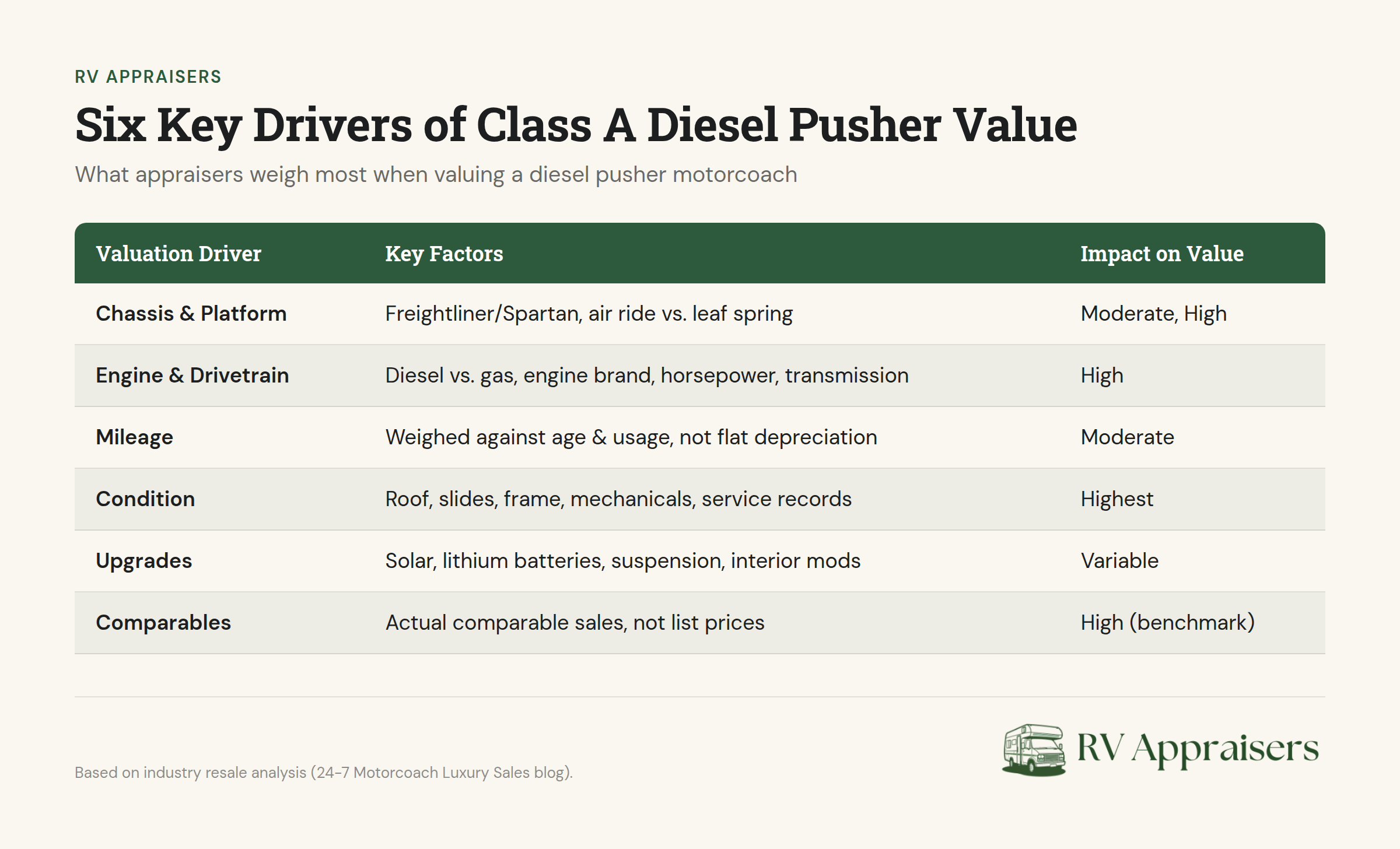
Six factors do most of the work in a motorcoach appraisal: chassis, engine and drivetrain, mileage, condition, upgrades, and comparable sales. None of these are optional line items; each one shifts the value conclusion in a measurable way.
Chassis and platform. The chassis manufacturer (Freightliner and Spartan are the two most common in this class) and the suspension type, air ride versus leaf spring, affect ride quality, load capacity, and long-term durability. Premium chassis and independent front suspension typically command a market premium over basic setups.
Engine and drivetrain. Diesel pushers hold value meaningfully better than gas-powered motorhomes because diesel engines generally last longer and handle towing loads with less strain, according to industry resale analysis. Engine brand and horsepower rating, along with transmission type, matter more in this segment than in almost any other RV category.
Mileage. Mileage means something different on a motorcoach than on a passenger car. A 10-year-old coach with 50,000 miles is considered low-mileage, so appraisers weigh mileage against age and documented usage pattern rather than applying a flat depreciation curve.
Condition. This is the single biggest swing factor. Roof seals, slide-out mechanisms, and frame condition are treated as critical, since chronic leaks or slide failures can destroy value fast. Interior condition, appliance function, upholstery, and any history of water damage carry similar weight. Mechanical condition, documented service records, tire age, generator health, matters just as much as cosmetics.
Upgrades. Solar arrays, lithium battery banks, suspension upgrades, and modernized interiors add real value when they're the kind of upgrade the broader buyer pool actually wants. A full exterior paint conversion or a documented coach-builder modification can raise or lower value significantly depending on execution quality, and an appraiser has to evaluate that work on its own merits rather than assume it adds dollar-for-dollar value.
Comparables. Well-maintained diesel pushers from premium manufacturers can retain a notably higher share of their original price after a decade than mass-market coaches, and appraisers lean on actual comparable transactions, not list prices, to support that conclusion.
Example: Two otherwise identical 2016 diesel pushers can appraise thousands of dollars apart if one has a documented roof reseal and full maintenance log while the other has unexplained gaps in service history and visible interior water staining.
How the Motorcoach Appraisal Process Works
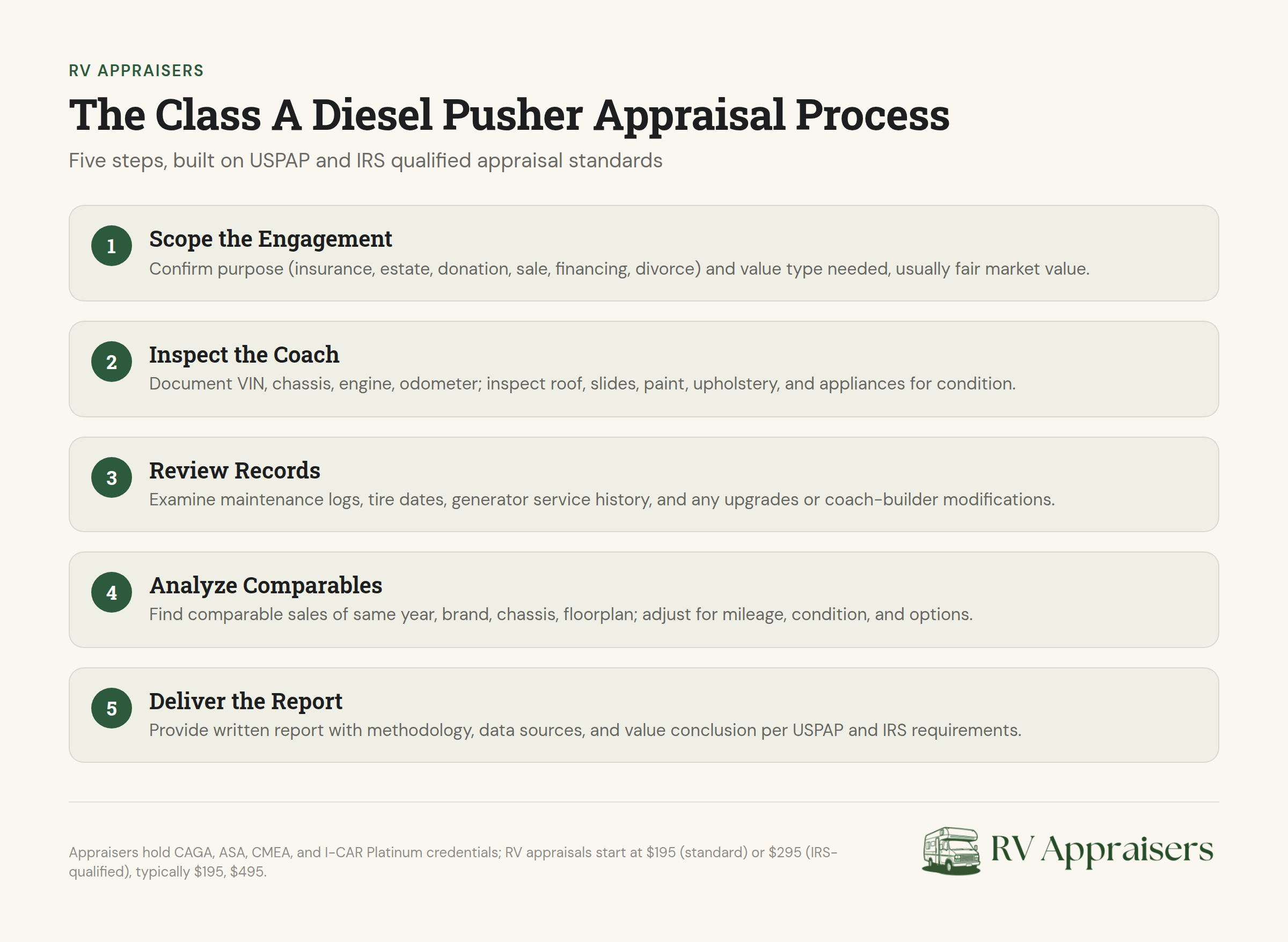
Our appraisers follow a structured process for every Class A diesel pusher engagement, built around recognized personal property appraisal standards rather than a quick drive-by estimate.
- Scope the Engagement
- We confirm the purpose (insurance, estate, donation, sale, financing, or divorce) and the type of value needed, almost always fair market value.
- Inspect the Coach
- We document the VIN, chassis, and engine details, record the odometer reading, and inspect the roof, slides, paint, upholstery, and appliances for condition issues.
- Review Records
- We examine maintenance logs, tire replacement dates, generator service history, and documentation of any upgrades or coach-builder modifications.
- Analyze Comparables
- We identify comparable sales of similar year, brand, chassis, and floorplan, then adjust for mileage, condition, and options.
- Deliver the Report
- We prepare a written report that documents methodology, data sources, and the final value conclusion, prepared in accordance with USPAP and, where applicable, the IRS's qualified appraisal requirements.
Our appraisers hold credentials such as CAGA, ASA, CMEA, and I-CAR Platinum, and every motorcoach report is prepared in accordance with USPAP. Fees are quoted as a fixed amount before work begins, scoped to the coach's complexity and the intended use of the report; our recreational vehicle appraisals start at $195 for standard reporting and $295 for IRS-qualified reports, with typical engagements running $195 to $495 depending on documentation and scope.
Frequently Asked Questions
Q: Does mileage matter more for a diesel pusher than for a gas-powered RV? Mileage is weighed differently, not necessarily more heavily. Because diesel drivetrains are built for longevity, a coach with moderate mileage and strong maintenance records can appraise higher than a low-mileage coach with a spotty service history. Appraisers look at mileage relative to age and documented use, not mileage alone.
Q: What if the motorcoach has custom coach-builder modifications? Custom work has to be evaluated on its own merits rather than assumed to add value automatically. A well-executed structural or mechanical modification with documentation can support a higher value, while an undocumented or poorly integrated modification can actually work against the coach in a comparable-sales analysis.
Q: Do you appraise motorcoaches registered for commercial or interstate use? Yes. Commercial or interstate registration doesn't change the appraisal methodology, but it does change the documentation reviewed, since usage records, inspection history, and any commercial modifications become part of the condition and comparables analysis.
Q: How much does a full exterior paint conversion or a slide-out replacement affect value? Both can move the value meaningfully, in either direction. A high-quality, professionally executed paint conversion often adds value, while a slide mechanism with a documented repair history needs to be evaluated for long-term reliability, not just current function.
Q: Is a motorcoach appraisal different from a travel trailer appraisal? Yes. A travel trailer has no engine, chassis, or drivetrain, so its appraisal focuses almost entirely on structure, interior condition, and comparables. A motorcoach appraisal adds an entire additional layer of analysis around chassis reputation, engine and transmission specifics, and drivetrain maintenance history.
Whatever is driving the need for an appraisal, insurance, an estate, a donation, a sale, financing, or a divorce, the fundamentals stay the same: a motorcoach's value comes from its chassis, its drivetrain, its documented condition, and real comparable sales, not a generic guidebook number. Getting that analysis right the first time avoids disputes down the road, whether the other party is an insurer, a court, or the IRS.
This article is provided for general informational purposes only and does not constitute legal, tax, or financial advice. Readers should consult a qualified attorney or CPA regarding their specific circumstances.