
Blog
Agreed Value RV Insurance Appraisal: How to Protect Your Motorhome's Full Value
An agreed value RV insurance appraisal locks in a pre-negotiated payout for a total loss, removing depreciation from the settlement math entirely. This guide explains how agreed value differs from actual cash value and stated value coverage, and how a professional appraisal documents the number your insurer agrees to pay.
Owners who have customized, restored, or simply held onto a motorhome for years share the same fear: a total loss that pays out a fraction of what the RV is actually worth. Agreed value coverage solves that problem by fixing the payout amount before anything happens, rather than leaving it to a depreciation formula after a loss. This guide breaks down how agreed value RV insurance appraisal works, how it differs from actual cash value and stated value policies, and how total loss and diminished value claims play out differently under each.
What Is an Agreed Value RV Insurance Policy?
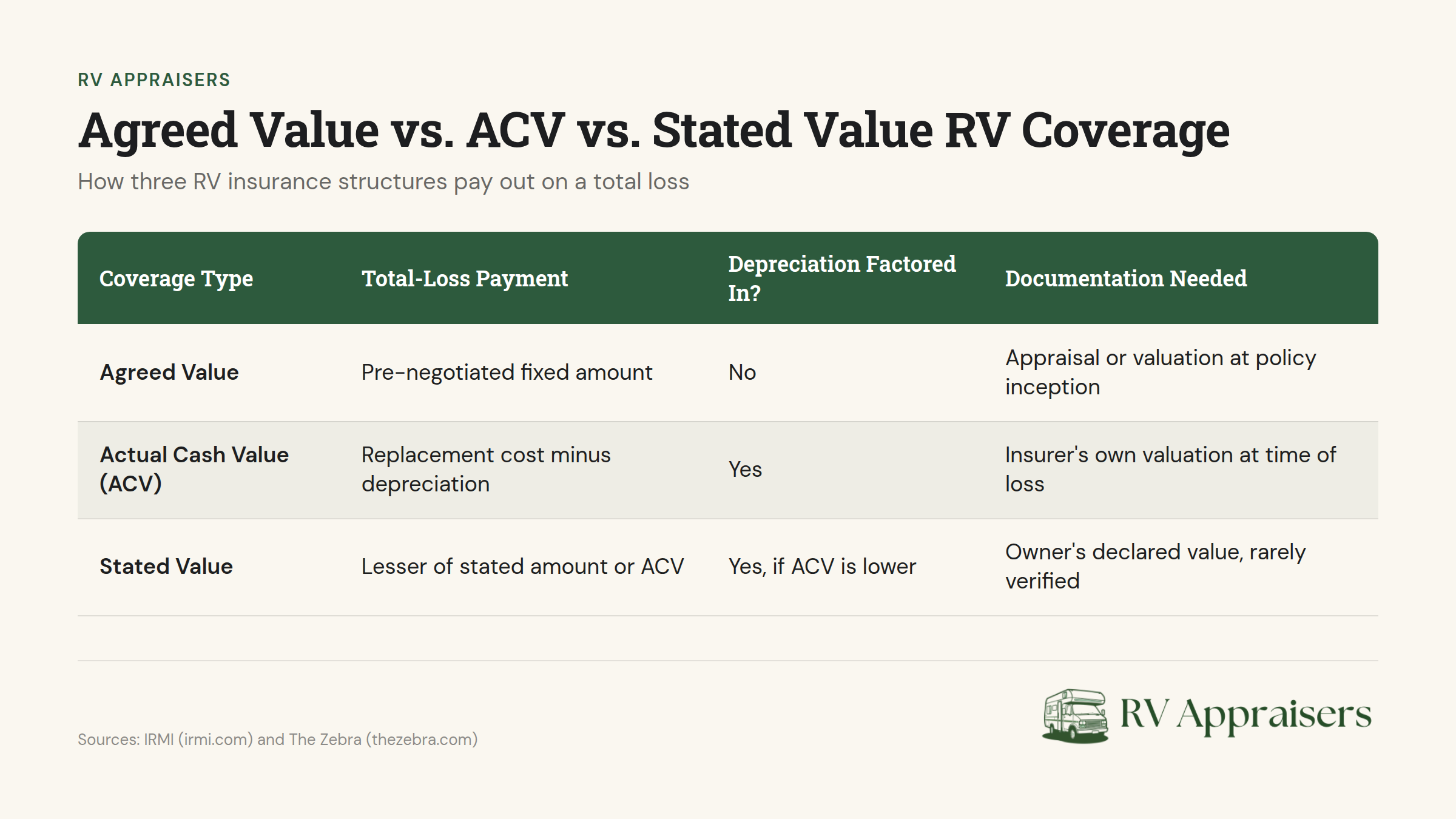
An agreed value policy is one where the insurer and the owner pre-negotiate a specific dollar amount for the RV, and that figure becomes the guaranteed payout if the vehicle is declared a total loss. There is no depreciation calculation at the time of the claim. The number on the declarations page is the number you get paid, full stop.
This is different from how most standard auto and RV policies work. Actual cash value (ACV) policies pay whatever the vehicle is determined to be worth at the moment of loss, which usually means replacement cost minus depreciation, and that figure can shrink significantly for an older motorhome (IRMI). Stated value policies sit in between: the owner declares a value when the policy is written, but the insurer typically still reserves the right to pay whichever is lower, the stated amount or the calculated ACV (The Zebra).
That distinction matters because a stated value is really just a ceiling, not a guarantee. An agreed value is a contract. If your insurer offers agreed value coverage on an RV appraisal for insurance claim purposes, understanding which of these three structures you actually have is the first step before you ever file a claim.
| Coverage Type | Total-Loss Payment | Depreciation Factored In? | Documentation Needed |
|---|---|---|---|
| Agreed Value | Pre-negotiated fixed amount | No | Appraisal or equivalent valuation at policy inception |
| Actual Cash Value (ACV) | Replacement cost minus depreciation | Yes | Insurer's own valuation at time of loss |
| Stated Value | Lesser of stated amount or ACV | Yes, if ACV is lower | Owner's declared value, rarely independently verified |
Who Benefits Most From Agreed Value Coverage
Agreed value coverage delivers the most protection to owners whose RV would be hard to replace at a generic book value. If your motorhome has been customized, meaningfully upgraded, or maintained well past the point where a depreciation schedule reflects its real condition, agreed value coverage is worth pursuing.
Three types of owners see the clearest benefit:
- Owners of highly customized RVs. Aftermarket solar systems, custom cabinetry, upgraded suspension, or a reworked interior rarely show up in a standard market guide, so an ACV settlement typically ignores that added value entirely.
- Owners of older or collectible motorhomes. A well-preserved vintage Airstream or a limited-production coach can be worth far more to a collector than a depreciation curve would suggest.
- Owners who have invested heavily in maintenance or restoration. A mechanically sound older RV with extensive documented service history often outperforms its book value, but only an independent appraisal captures that.
Watch out: Agreed value coverage generally has to be arranged and documented before a loss occurs. You cannot wait until after a claim to argue the RV was worth more than the policy reflects; the agreed figure is meant to be locked in at binding or renewal.
How a Professional RV Appraisal Establishes Your Agreed Value
A USPAP-compliant appraisal is what turns a rough estimate into an insurable, contractually binding number. Insurers accept agreed value coverage because a qualified appraisal gives them a documented basis for that figure, not because the owner simply asked for a higher number.
A proper RV appraisal for agreed value purposes typically documents:
- Make, model, year, and configuration, including chassis type, mileage, and engine hours where applicable
- Condition at inspection, covering the exterior, interior, mechanical systems, and any water damage or structural concerns
- Modifications and upgrades, itemized with their contribution to value rather than lumped into a single adjustment
- Comparable market data, drawn from actual sales of similar coaches rather than generic depreciation tables
Our appraisers hold credentials with organizations such as CAGA (the Certified Appraisers Guild of America), the ASA (American Society of Appraisers), and I-CAR Platinum, and every report is prepared in accordance with USPAP, the standard published by The Appraisal Foundation. That combination gives insurers a report they can rely on when setting the agreed figure, and gives owners a document they can point back to if a claim is ever disputed.
For a standard recreational vehicle appraisal, fees are quoted as a fixed amount after we scope the assignment based on the RV's complexity, documentation available, and intended use. Standard reports for insurance purposes typically start at $195, with advanced, more heavily documented reports starting at $295. Engagements are quoted as a fixed fee before work begins, never billed hourly.
Pro tip: Send your insurer the completed appraisal report, not just a summary letter. Carriers reviewing agreed value applications generally want to see the full valuation methodology, not just a bottom-line number.
How Often Should You Update Your RV Appraisal?
An agreed value figure is only as good as the appraisal behind it, and RVs change value for reasons that have nothing to do with age alone. Depreciation, added upgrades, and shifting demand for a given floor plan or brand can all move the number in either direction.
As a general practice, plan to have your RV reappraised:
- Every 2 to 3 years, even without changes, since market conditions for used RVs shift meaningfully over that window.
- After any major modification or restoration, such as a new engine, a redesigned interior, or added solar and battery systems.
- At policy renewal, if your insurer requires periodic re-certification to keep agreed value coverage active. Some carriers waive coinsurance-style penalties specifically because the value has already been documented in advance (My New Markets), but that waiver typically depends on keeping the valuation current.
Owners weighing whether an updated appraisal is worth the cost can review how RV appraisal pricing works in more detail before scheduling one.
Total Loss and Diminished Value Claims: Why the Policy Type Changes the Outcome
The policy structure you carry determines not just how much you get paid, but which type of claim even applies. This is where agreed value coverage diverges most sharply from ACV and stated value.
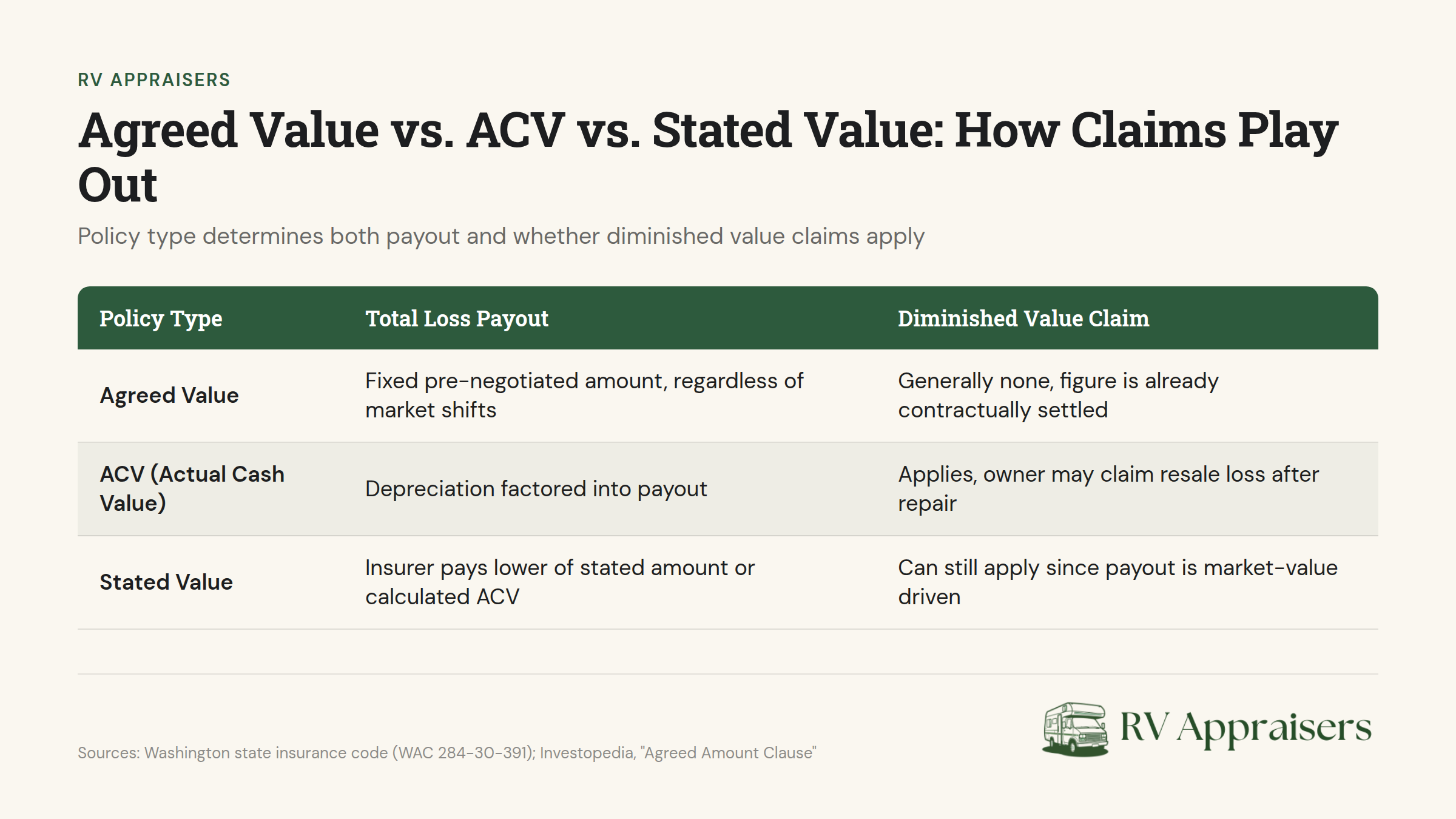
Under an agreed value policy, a total loss triggers payment of the pre-negotiated amount shown on the declarations page, regardless of how the RV's market value may have shifted since the policy was written. Because that figure is already fixed, there is generally no separate diminished value component to negotiate; the contract has already settled the number. Some state regulations reinforce this by requiring insurers to confirm the agreed figure reasonably reflects a comparable vehicle's value when the policy is issued, not when the claim is filed (Washington state insurance code).
Under an ACV policy, the calculation runs in the opposite direction. Depreciation is factored into a total loss payout, and it also shapes how the insurer values a partial loss or a repaired vehicle. This is where diminished value claims become relevant: if the RV is repaired after an accident but is now worth less on resale because of its accident history, the owner may have grounds to pursue the difference separately from the repair cost itself.
Under a stated value policy, the insurer typically still has the option to pay whichever is lower, the stated amount or the calculated ACV, so an owner can be surprised to learn the stated figure was never a guarantee (Investopedia). Diminished value arguments can still apply here, since the payout is ultimately market-value driven rather than contractually fixed.
Key takeaway: Agreed value coverage trades flexibility for certainty. You give up the chance that a claim adjuster might value your RV higher than expected, but you also eliminate the risk of a lowball depreciation-based settlement, and you generally remove diminished value disputes from the total-loss equation entirely.
Protecting Your RV's Real Value Before You Need To
Agreed value coverage only works as well as the number behind it. An insurer will accept a pre-negotiated figure, but that figure needs to be defensible, current, and backed by a report that holds up if a claim is ever questioned. That is what a professional appraisal is for: not a formality for the file, but the evidence that makes the agreed amount real.
If you are setting up agreed value coverage for the first time, updating an existing policy, or preparing for a claim, our team can request an RV appraisal built around your specific coach, its modifications, and its condition.
This article is provided for general informational purposes only and does not constitute legal, tax, or financial advice. Readers should consult a qualified insurance professional or attorney regarding their specific policy and circumstances.